Reviews vs Rankings: What Reviews Actually Do
You have been told reviews are critical for SEO. You have also been told reviews do nothing for SEO. Both statements get repeated confidently, often…
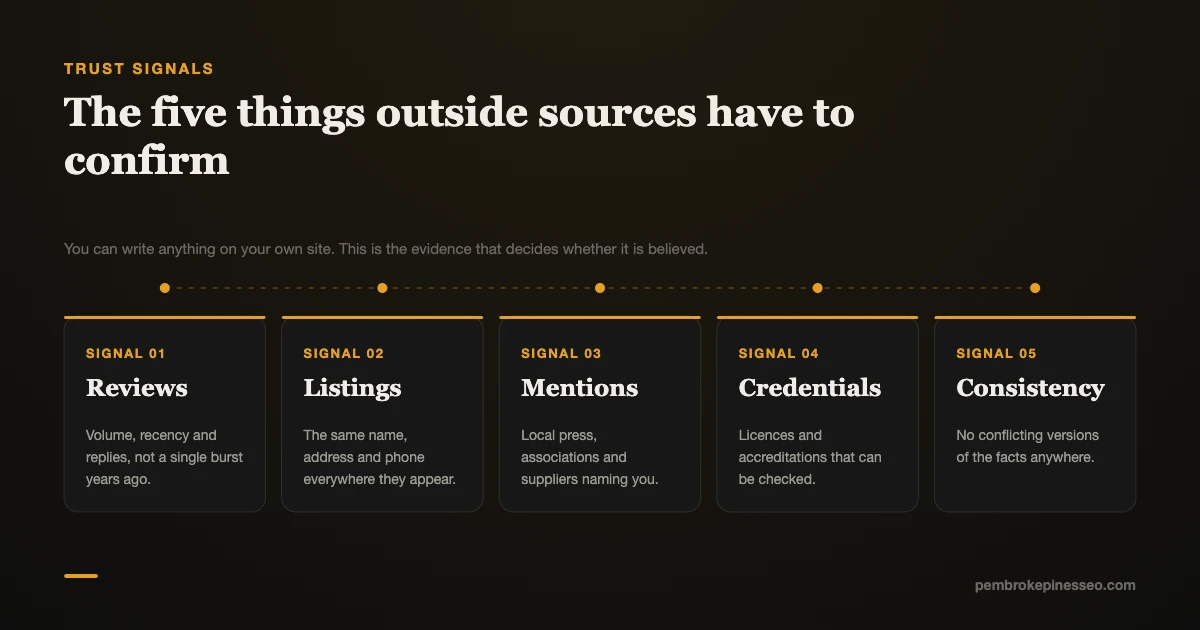
Read article →Trust signals are the evidence about your business that exists somewhere you do not control: reviews, directory listings, local press, community mentions, and the consistency between all of them. They are how a search engine or an AI system moves from "this business claims to do X" to "this business does X," and they are the fourth of the 5 signals.
For most established Broward County businesses, this is the signal with the biggest gap between reality and record. You have 20 years of satisfied customers and 14 Google reviews. The reputation is real. The evidence is thin.
A trust signal is any independent confirmation of your business's identity, quality, or existence. Reviews and their recency, star rating, and response rate. Directory listings carrying identical name, address, and phone. Mentions in local news, association directories, and community platforms. Links from other websites. Licenses and credentials that can be checked.
The common thread is independence. Anything you can edit yourself is a claim. Anything a third party publishes is corroboration.
Trust signals now carry weight in three separate systems at once, which is new.
For Google Maps, they feed prominence, one of the three stated local ranking factors. For customers, they are the last thing checked before a call. And for AI tools, they are the corroboration layer that determines whether your business gets named at all.
Research from Omniscient Digital analyzing more than 23,000 citations found that a brand's own content accounted for only about 23% of citations on branded queries. Roughly three quarters of what an AI system says about a business comes from sources that business does not own.
Which means you can build a perfect website and still lose the AI answer to a competitor with a thinner site and a thicker trail of outside confirmation.
The bar moved sharply in a single year, and the numbers are worth knowing precisely because they are thresholds rather than trends.
BrightLocal's Local Consumer Review Survey 2026, a representative panel of 1,002 US adults, found:
That last figure is the one Broward businesses ignore. Google's share of review platform usage fell from 83% to 71% in the same survey, while Apple Maps nearly doubled and AI tools jumped from 6% to 45%. A Google-only reputation strategy now covers a shrinking fraction of the people evaluating you.
One useful counterpoint on ratings: a perfect 5.0 is not the goal. Separate research from Northwestern University's Spiegel Research Center places the optimal trust range around 4.2 to 4.5 stars, because a flawless score reads as filtered.
Volume gets you past the consideration threshold. Recency proves you are still operating. A 4.9-star profile whose newest review is 14 months old reads worse than a 4.5 with three reviews this month.
The practical target is a steady trickle rather than a burst. Ten reviews in one week after two silent years looks like what it is. Two or three per month, indefinitely, is the pattern that holds up.
Never gate requests by asking how someone feels first and only routing the happy ones to Google. It violates platform policy and, since the FTC's fake review rule took effect, it sits in genuinely risky territory.
Respond to all of them, not just the bad ones. Responses are read by customers, indexed by Google, and increasingly summarized by AI tools describing what it is like to work with you.
Write like a person. Generic templated replies repeated 40 times reduce trust rather than building it, and they read as automated to both humans and machines.
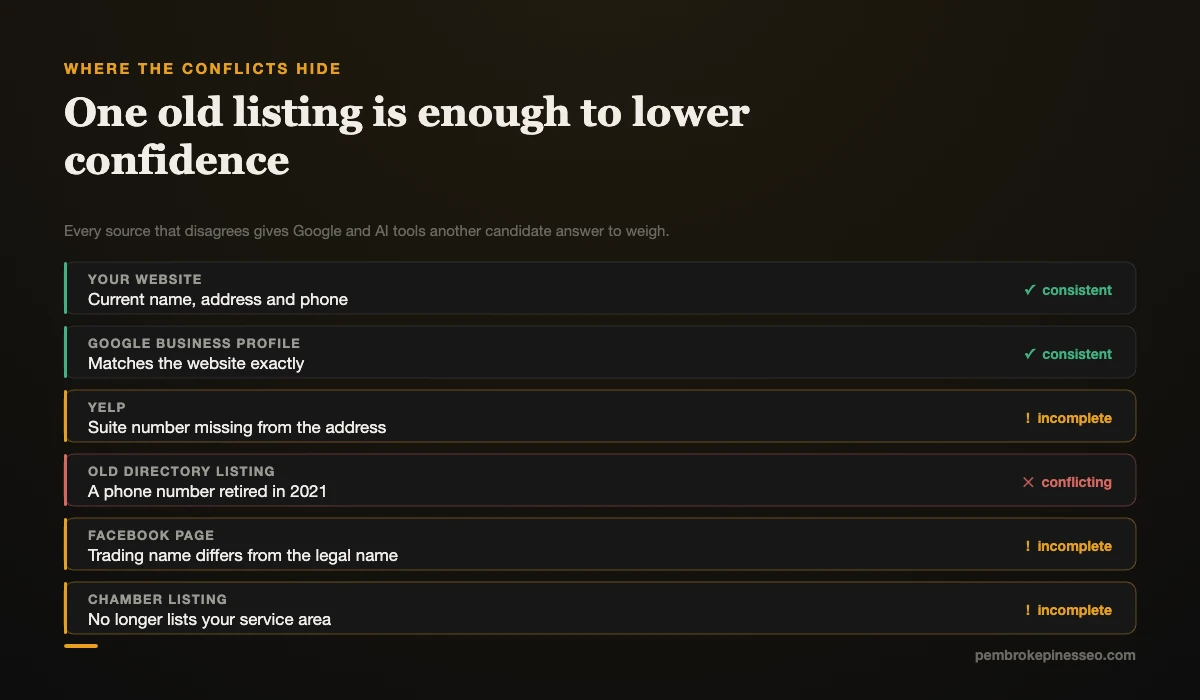
Your name, address, and phone number must be byte-identical everywhere. "Ste 217" in one place and "Suite 217" in another is a mismatch. An old cell number on a 2019 directory listing is a mismatch.
Each inconsistency lowers a system's confidence in your entity. Semrush frames this bluntly: inconsistent information across multiple sources fragments your entity and deters AI platforms from surfacing it.
Audit this quarterly. It takes less time than owners assume and it is the cheapest prominence work available.
Beyond Google: Apple Business Connect, Bing Places, Yelp, and the directories that matter for your specific trade. Angi and Houzz for home services. Zocdoc and Healthgrades for medical practices. Avvo for legal. Chamber and association directories for everyone.
The point is not traffic from these listings. Most send very little. The point is that 15 sources saying the same thing is what converts a claim into a verified fact.
Chamber of Commerce membership, youth league sponsorship, a quote in a Broward business publication, a mention in a neighborhood group. These build the local relevance layer that a national directory listing cannot.
Freshness compounds here. Ahrefs' analysis of 17 million AI citations found AI-cited content was on average 25.7% fresher than traditionally ranked content. A profile or mention updated last month is a stronger signal than the identical one from 2023.
The AI Visibility Snapshot™ scores you across Google, Maps, your website, your competitors and AI tools, then gives you a prioritised 90-day roadmap.
Get My Snapshot →Do this with a notepad. It takes about 40 minutes and it usually produces two or three surprises.
Every mismatch you find is a small deduction from your prominence and from an AI system's confidence. Most Broward businesses find between three and eight.
Trust signals do not overcome distance in Google Maps. A business in Weston will not outrank Pembroke Pines businesses for a search from a Pembroke Pines driveway on review count alone.
They also do not guarantee an AI mention. Nobody controls what ChatGPT or Gemini says, and any service promising a recommendation is describing an outcome it does not own. What strong trust signals do is make you the easiest business in your category to verify, which is what verification-dependent systems reward.
Reviews prove quality. They do not prove identity or relevance on their own. All 5 signals work together, which is why we score them together rather than separately.
If you do one thing this week, do the NAP audit. It costs nothing, it takes 40 minutes, and it is the only trust signal work that improves your Google Maps prominence and your AI verification at the same time with no ongoing effort.
Then start the review request habit, because it is the slowest to compound and the earliest start wins.
If you would rather see your trust signals scored against two or three visible Broward competitors, alongside your Google, Maps, website, and AI visibility, that is what the AI Visibility Snapshot covers.
Get My AI Visibility Snapshot → Find out where you're invisible in Pembroke Pines before your competitors do.
We help businesses across Pembroke Pines, Miramar, Hollywood, Davie, Weston, Cooper City, Hallandale Beach, and greater Broward County improve their visibility in search and AI-powered results.

We help established Pembroke Pines and Broward County businesses become easier to find, understand, trust and recommend across Google, Google Maps and AI tools like ChatGPT, Gemini and Perplexity.

You have been told reviews are critical for SEO. You have also been told reviews do nothing for SEO. Both statements get repeated confidently, often…
Read article →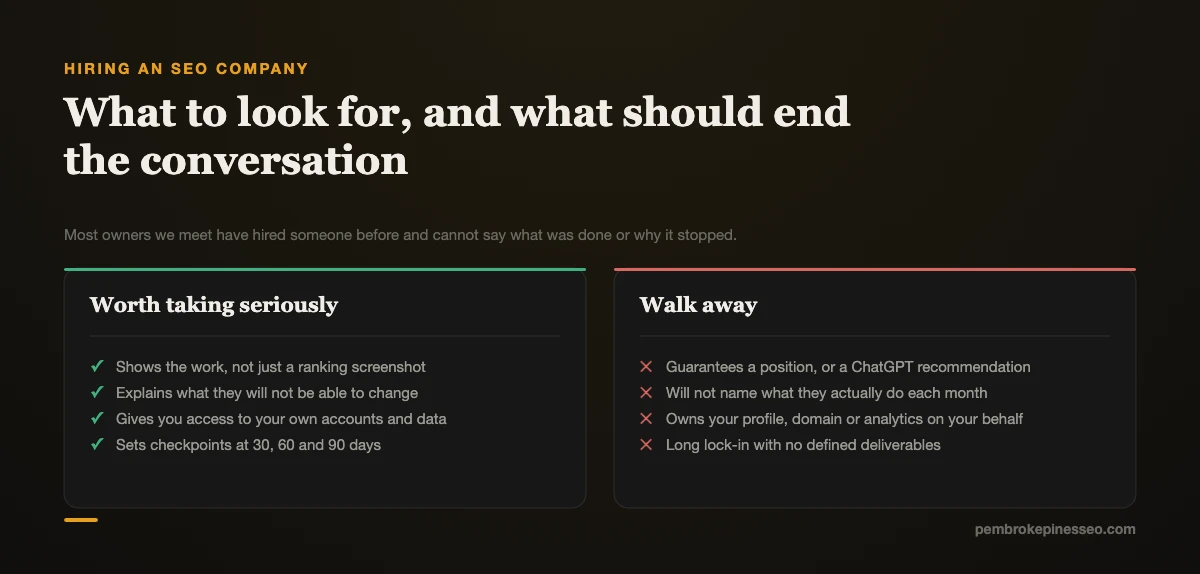
Most Broward business owners we talk to have hired an SEO company before. A meaningful number of them cannot say what that company did, what it cost…
Read article →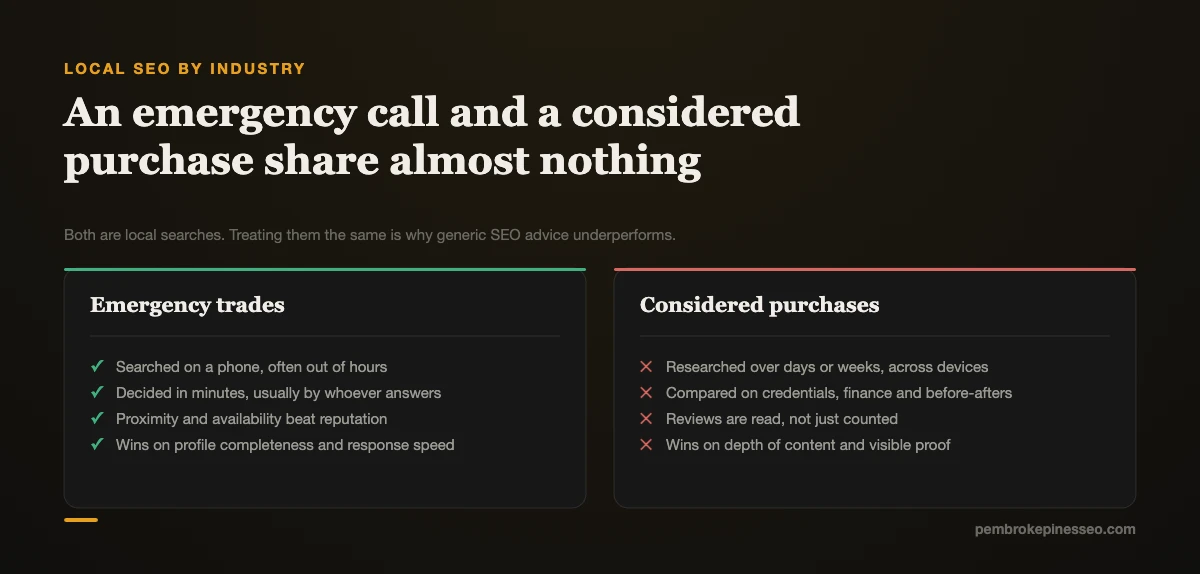
A homeowner whose air conditioning died at 2pm in August and a homeowner considering Invisalign are both "local searches." They have almost nothing…
Read article →Get a clear, specific picture of your visibility across Google, Maps and AI tools — and the exact roadmap to fix it. Built for Pembroke Pines & Broward County businesses that already do great work.
Get My AI Visibility Snapshot →