Trust Signals for Local Businesses: What Google and AI Both Verify
You can write anything you want on your own website. That is exactly why neither Google nor ChatGPT fully believes it.
Read article →You have been told reviews are critical for SEO. You have also been told reviews do nothing for SEO. Both statements get repeated confidently, often by people selling something, and the contradiction leaves you unsure whether chasing reviews is worth the effort.
 Pembroke Pines SEO Company
9 min read
Pembroke Pines SEO Company
9 min read

The confusion exists because "rankings" describes two different results, and reviews behave differently in each.
Reviews affect your Google Maps and Local Pack ranking directly, and Google documents this. They have little direct effect on organic blue-link rankings for your website pages. Their largest effect is not on ranking at all: it is on whether a customer chooses you once they see you, and whether AI tools can verify you well enough to recommend you.
So the honest answer is yes, no, and yes, depending on which system you mean. Here is each one.
Google states publicly that local results are based primarily on relevance, distance, and prominence. On prominence, Google's own Business Profile documentation says the factor is based on information including how many websites link to your business and how many reviews you have, and that more reviews and positive ratings can improve your local ranking.
That is unusually direct for Google. Most ranking claims in this industry are inference. This one is documented.
What Google does not publish is any weighting. Nobody outside Google knows whether the jump from 20 reviews to 60 matters more than the jump from 4.2 stars to 4.6. Any article giving you a precise percentage is presenting an opinion survey or a guess as fact.
Whitespark's Local Search Ranking Factors survey, which polls local search practitioners and released its 2026 edition in November 2025, is the closest thing the industry has to a consensus view. BrightLocal's overview of the local algorithm explains how that survey works. Treat it as informed expert opinion, which is what it is, rather than as a leaked weighting.
Prominence is one of three factors, and one of the other two is distance, which you cannot change.
In a spread-out market that barely matters because the nearest real competitor is far away. Here it matters enormously. Pembroke Pines, Miramar, Cooper City, Davie, and Hollywood sit within a short drive of each other, which means a searcher's exact position decides which businesses are even eligible before prominence gets considered.
The practical consequence: reviews are one of the few levers that can pull you into contention in a neighboring city where you lose the distance comparison. They will not overcome distance entirely. A business in Weston will not beat Pembroke Pines businesses for a search from a Pembroke Pines driveway on review count alone. But between two businesses at similar distance, prominence is often what separates them, and reviews are the most accessible part of prominence for a small operator.
We cover how the three factors interact in Google Maps ranking for Pembroke Pines businesses.
Your Google Business Profile and your website are ranked by different systems. Reviews feed the first. They do not meaningfully feed the second.
This is the distinction most articles on this topic blur, usually because the article exists to sell a review-collection tool and "reviews help SEO" is a cleaner sales line than "reviews help one of the two systems you care about."
If your goal is to rank a service page for a competitive search, reviews are not the lever. Content depth, service and service-area clarity, internal linking, and site authority are. Collecting 40 more reviews will not lift a thin service page.
Reviews displayed on your own website with valid review schema can produce star ratings in organic results for eligible page types. That does not change your ranking position. It changes how your existing listing looks, which can improve click-through rate.
Worth doing where it applies. Not a ranking strategy, and be careful here: schema rules for review markup are specific about what content types qualify, and invalid or self-serving markup can lose you the rich result entirely.
Not all review activity does the same job. Three attributes behave differently and are worth separating.

| Attribute | What it does | How to read your own position |
|---|---|---|
| Volume | Gets you past the threshold where a customer or a system will consider you at all | Compare to the three businesses currently ranking for your main search, not to a universal target |
| Rating | Filters you in or out before anyone reads a word | A perfect 5.0 across few reviews reads as unrepresentative to both people and systems |
| Recency | Signals that you are still operating and still good | A strong profile whose newest review is a year old is a weaker signal than a slightly lower one updated last month |
Recency is the one owners underestimate most. A steady two or three reviews per month, indefinitely, outperforms 40 collected in one push and then nothing. The steady pattern also looks natural, which the burst does not.
Responding matters too, though not the way it is usually sold. Google encourages owners to respond, and responses are read by customers and indexed. Do not expect a position change from replies alone. The value is in trust and conversion.
Here is the reframe worth sitting with.
Ranking gets you seen. Reviews decide what happens next, and that second step is where most local businesses actually lose.
Consider what a top-three Map Pack position is worth if your profile shows 11 reviews at 3.9 stars sitting beside two competitors with 140 and 210 at 4.7. You won the ranking and lost the customer. The position was never the bottleneck.
BrightLocal's Local Consumer Review Survey 2026, based on a representative panel of 1,002 US adults, found that 68% of consumers now require a minimum of 4 stars, up from 55% the previous year, and 47% will not consider a business with fewer than 20 reviews. Those are not preferences. They are filters applied before you get read.
So if you are choosing where to spend limited effort, the question is not "will this move my ranking." It is "will this survive the comparison a customer runs in eight seconds."
The AI Visibility Snapshot™ scores you across Google, Maps, your website, your competitors and AI tools, then gives you a prioritised 90-day roadmap.
Get My Snapshot →There is now a third place your reviews do work, and none of the articles competing for this query mention it.
When someone asks ChatGPT, Gemini, or Perplexity for the best option in Pembroke Pines, the assistant has to decide which businesses it can confidently name. That decision runs on verification: can it establish what your business is, that it operates where you say, and that independent sources agree.
Reviews feed that directly. They are third-party content the business does not control, which is exactly the kind of corroboration these systems weight. They also supply the descriptive language an assistant uses when it explains why it recommended you. An assistant saying "consistently praised for emergency response" is reading your reviews, not your homepage.
This is a genuinely separate system from the Map Pack, with its own outcome. You can hold a top-three map position and be absent from every AI answer for the same query, and the reverse happens too. If that sounds like a problem worth checking, start with what AI search visibility means and how the five signals fit together.
Reviews are worth the effort. Just be clear about which return you are buying.
In all four cases the operating discipline is the same and unglamorous: ask consistently, respond to everything, never gate requests by screening for happy customers first, and keep going after the month you feel like stopping.
One caution on that third point. Filtering review requests so only satisfied customers reach Google violates platform policy, and since the FTC's rule on fake and manipulated reviews took effect, it carries real regulatory exposure. It is also unnecessary. A profile with a few honest three-star reviews and thoughtful replies reads as more credible than an unbroken wall of fives.
Reviews sit alongside four other signals that determine whether you get found at all. The full picture is in trust signals for local businesses.
Not directly in the way Google reviews do. They contribute to prominence as part of your wider reputation footprint, and they matter for verification by AI tools, which read across platforms rather than only Google. BrightLocal's 2026 survey found the average consumer now checks around six different review platforms, so a Google-only reputation covers a shrinking share of the people evaluating you.
No, and it creates real risk. Beyond platform enforcement, the FTC rule on fake and manipulated reviews carries civil penalties. It is also detectable by the people you are trying to convince: sudden volume from accounts with no history reads as purchased to anyone who scrolls.
Not necessarily, and a flawless score can work against you with customers. Research from Northwestern University's Spiegel Research Center places the purchase-likelihood sweet spot around 4.2 to 4.5 stars, because a perfect record reads as filtered or too small a sample to trust.
There is no published timeline and no reliable answer. What can be said is that the effect is gradual and cumulative rather than immediate, and that recency means the benefit decays if collection stops. Treat it as an ongoing operating habit, not a campaign with an end date.
Usually distance, category accuracy, or profile completeness. Reviews are one input into one of three factors. A competitor closer to the searcher with a precisely matched primary category can outrank a better-reviewed business that is farther away or categorized too broadly.
The useful version of this question is not whether reviews affect rankings in general. It is which of the three systems is currently costing you business, because the answer changes what you should do on Monday.
Search your main service plus "Pembroke Pines" on your phone. Look at the three businesses in the Map Pack. Note their review counts, their ratings, and the date of their newest review. Then compare yours. That five-minute check tells you whether you have a ranking problem, a conversion problem, or neither.
If you would rather see all of it scored, including how your trust signals compare to two or three visible Broward County competitors and what AI tools currently say when asked for the best in your category, that is what the AI Visibility Snapshot covers.
Get My AI Visibility Snapshot →
Find out where you are invisible in Pembroke Pines, before your competitors do.
We help businesses across Pembroke Pines, Miramar, Hollywood, Davie, Weston, and Fort Lauderdale improve their visibility across Google, Maps, and AI search.
We help established Pembroke Pines and Broward County businesses become easier to find, understand, trust and recommend across Google, Google Maps and AI tools like ChatGPT, Gemini and Perplexity.
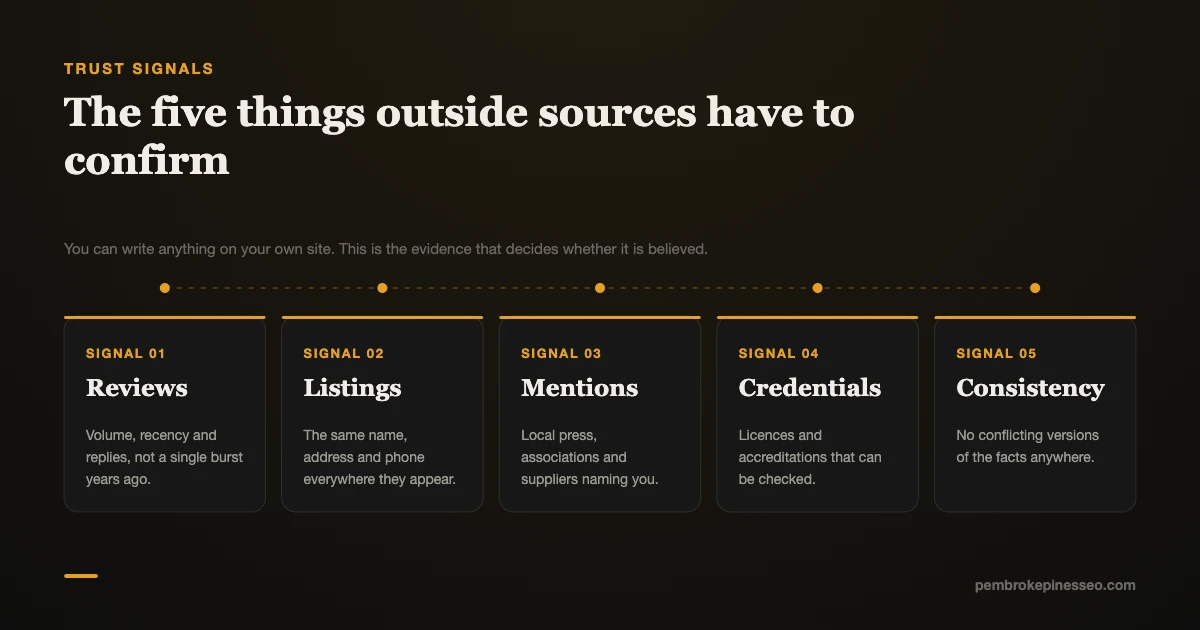
You can write anything you want on your own website. That is exactly why neither Google nor ChatGPT fully believes it.
Read article →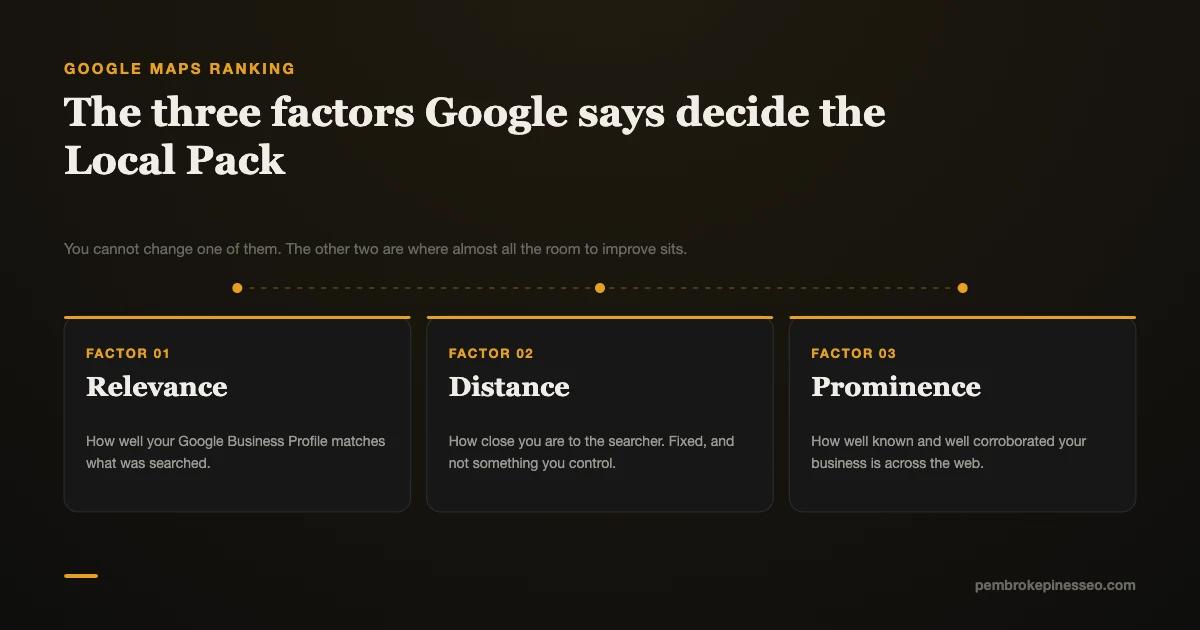
You have been in business for 18 years. Your reviews are better than the company three miles east. And when someone standing in a Pembroke Pines…
Read article →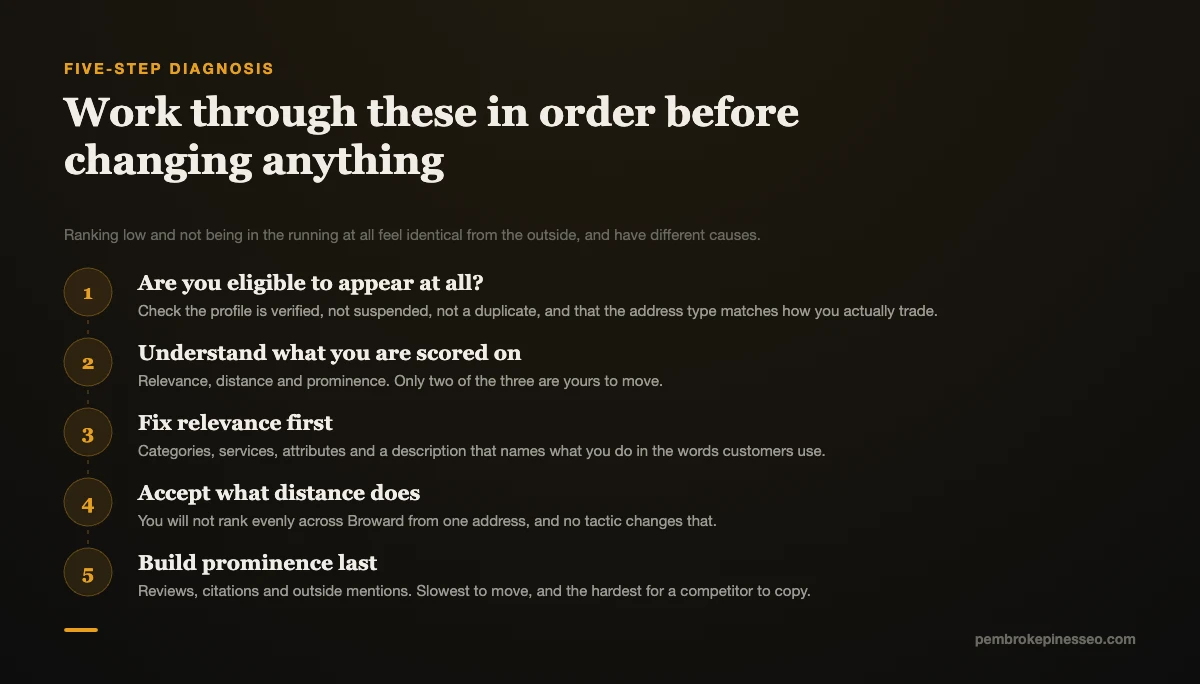
There is a version of this problem where you are ranked low, and a version where you are not in the running at all. They feel identical from the…
Read article →Get a clear, specific picture of your visibility across Google, Maps and AI tools — and the exact roadmap to fix it. Built for Pembroke Pines & Broward County businesses that already do great work.
Get My AI Visibility Snapshot →