How to Check If ChatGPT Recommends Your Business
Most owners run this check wrong, panic at the result, and draw the wrong conclusion.
Read article →A customer in Pembroke Pines needed your service last Tuesday. They did not open Google. They opened ChatGPT and typed "who's the best [your service] in Pembroke Pines?" They got three names. Then they called one.
 Pembroke Pines SEO Company
16 min read
Pembroke Pines SEO Company
16 min read
If you were not one of the three, you never knew the conversation happened. There is no impression, no click, no missed-call notification. Nothing shows up in your reporting, because nothing about you was ever shown.
AI search visibility is whether AI tools like ChatGPT, Google Gemini, Perplexity, and Google AI Overviews can find your business, understand what you do, verify that the information is true, and feel confident enough to name you in an answer. It is measured in mentions and citations, not in ranking positions. And it is now a separate outcome from your Google ranking, not a side effect of it.
This page explains what AI search visibility is, how AI systems actually choose which local business to recommend, and the five signals that determine whether your business is in the answer or absent from it.
AI search visibility is how often and how accurately AI assistants name your business when someone asks a question your business could answer. Unlike a Google ranking, which places your link on a page of results, AI search visibility determines whether your business appears inside the answer itself. A business can rank well on Google and still be invisible in AI answers.
That last sentence is the part most owners in Broward County have not absorbed yet. The two systems overlap, but they are scored separately, and one does not buy you the other.
AI search visibility became a distinct problem because Google and AI assistants now sit between your customer and your website, answering the question before any link is clicked. That layer did not exist five years ago.
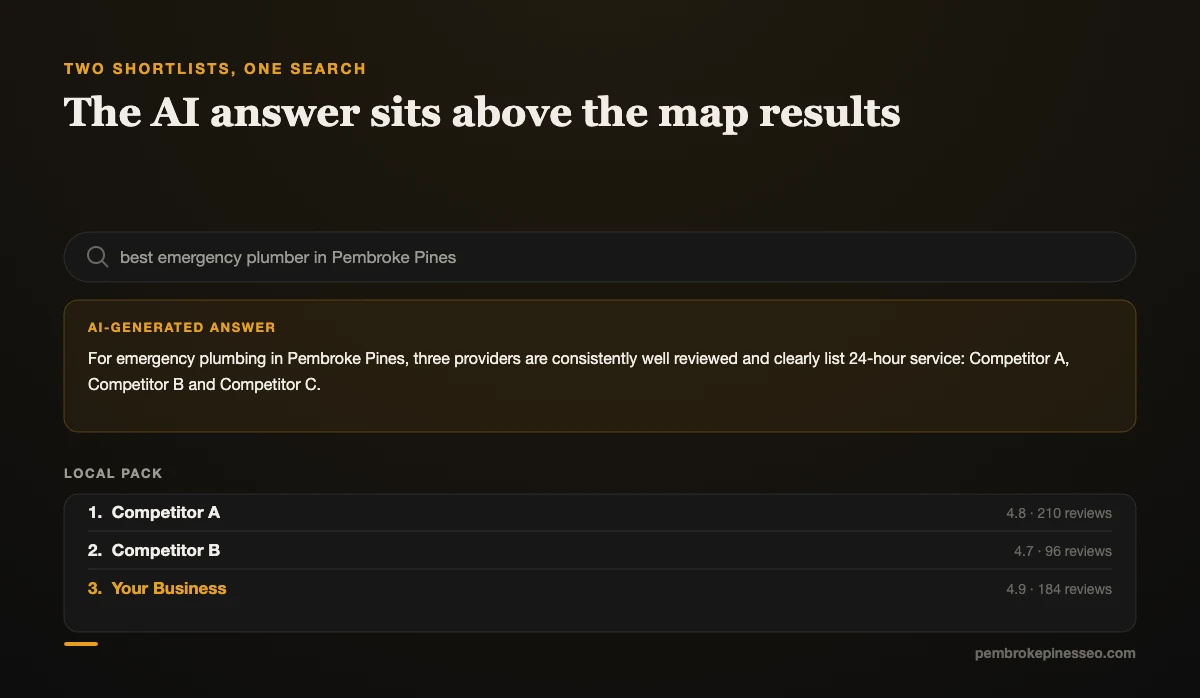
The scale of it is documented. A Whitespark study found AI Overviews appear on 68% of local business queries, while the traditional local pack appears on only 39% of the same searches. That is a 29-point gap where an answer is generated above the map, and often instead of it.
The gap widens with question-shaped searches. Whitespark's data shows informational local queries such as "how long does an eye exam take near me" trigger an AI Overview 92% of the time. Hybrid queries that combine cost and location, like "average cost of dental implants in Phoenix," hit 97%.
Read that against how Broward customers actually shop. A homeowner in Chapel Trail does not search "roofer." They ask what a tile roof replacement costs in South Florida, whether their insurer requires a specific underlayment, and how long a permit takes in Pembroke Pines. Those are exactly the queries that resolve inside an AI answer.
Clicking behavior has shifted with it. Pew Research Center found that when a Google AI summary is present, roughly 8% of users click a traditional link, compared with about 15% when no summary appears. Fewer clicks means the businesses named inside the answer capture a larger share of a smaller pool.
None of this means Google rankings stopped mattering. It means ranking is now one of five things that matter, and it is no longer the one that decides whether a customer hears your name.
AI assistants name a business when they can define it clearly, match it to the request, and confirm it from sources outside that business's own website. Semrush frames these three conditions as entity clarity, relevance, and corroboration, and that framing holds up well against what we see in audits.
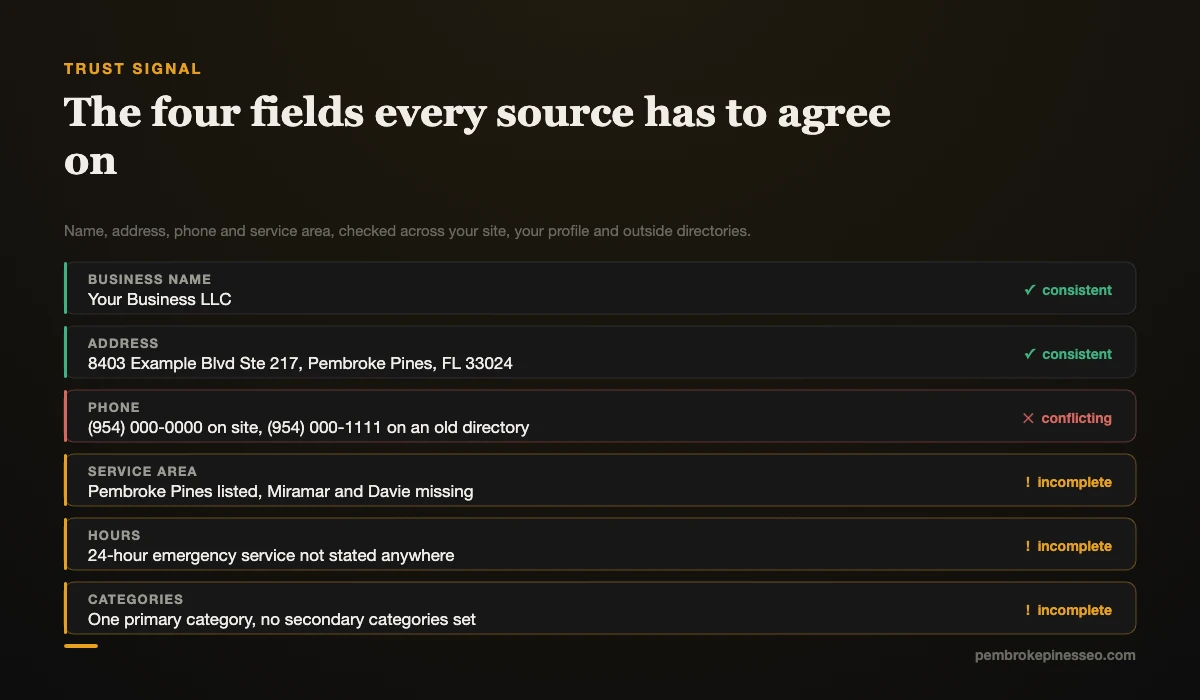
Entity clarity is whether an AI system can state plainly what your business is. Not your slogan. The facts: legal name, address, phone, service list, service area, hours, credentials. If those facts appear in four slightly different versions across your website, your Google Business Profile, Yelp, and an old directory listing, the system has four candidate answers and low confidence in all of them.
Relevance is whether your business fits the specific request. "Emergency AC repair in Miramar at 9pm on a Sunday" is a different question from "AC maintenance plan near me." If your website never states that you offer emergency service, or never names Miramar, you are not relevant to the first prompt no matter how good your work is.
Corroboration is outside confirmation. This is the part that surprises owners. Research from Omniscient Digital analyzing more than 23,000 citations found that a brand's own content accounted for only about 23% of citations on branded queries. The other 77% came from sources the brand does not control.
Your website is evidence. It is not proof. Proof is what everyone else says about you.
There is one more mechanical detail worth knowing, because it explains a lot of otherwise confusing results. Different assistants read different indexes. Google's AI Overviews and AI Mode draw on Google's index. ChatGPT's live search runs on Bing. Claude uses Brave. If your site is indexed in Google but not in Bing, you can appear in one AI tool and be entirely absent from another. Research reported by Spartan SEM, drawing on a Princeton analysis, found only about 11% of cited domains were shared across ChatGPT, Gemini, and Perplexity. AI visibility is not one channel. It is several, and they disagree with each other.
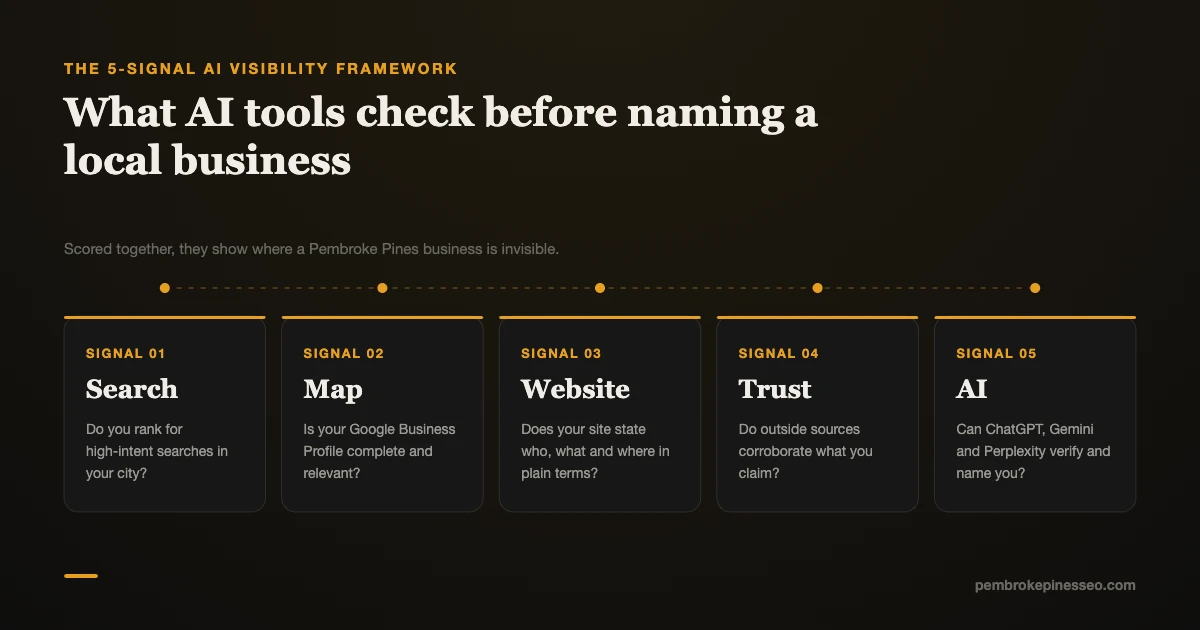
The 5-Signal AI Visibility Framework organizes everything above into five things that can be checked, scored, and fixed in order. We built it because the alternative, a flat list of twenty tactics, gives an owner no way to decide what to do first.
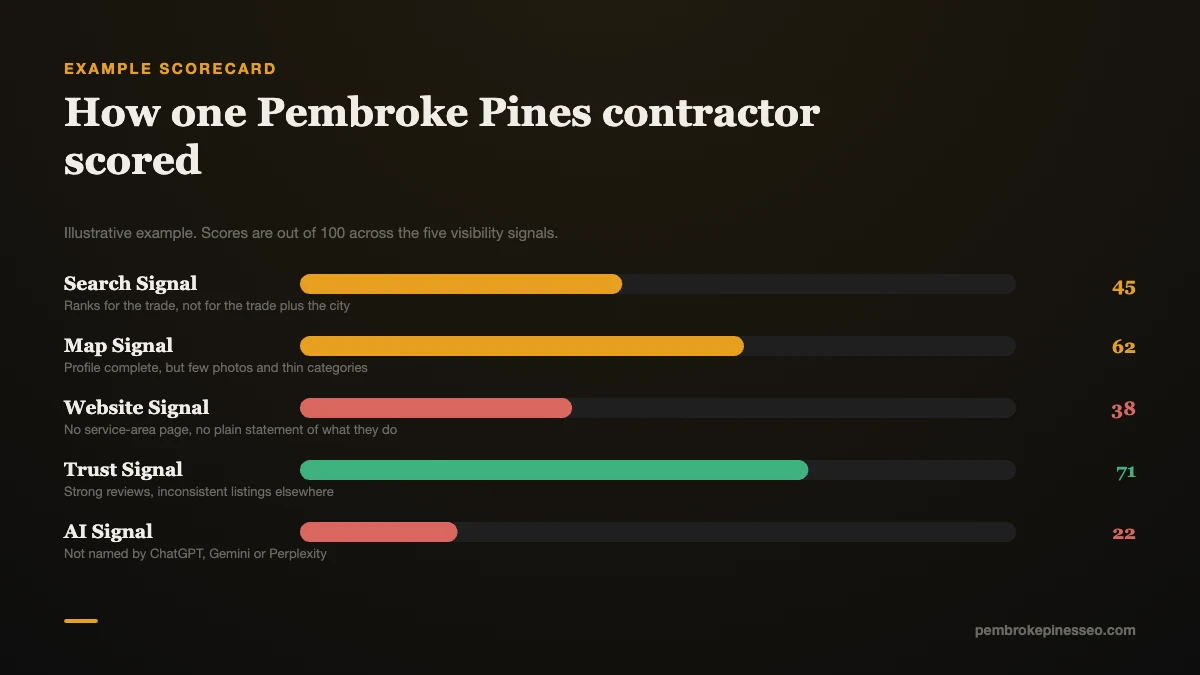
The signals are sequenced deliberately. Signals 1 through 4 build the evidence. Signal 5 is what the AI systems do with that evidence. You cannot skip to the end.
| Signal | What it measures | The question it answers |
|---|---|---|
| 1. Search Signal | Google visibility for high-intent queries | Do you appear for "[service] Pembroke Pines" and "[service] near me"? |
| 2. Map Signal | Google Business Profile strength | Are you in the Map Pack, with complete categories, photos, and reviews? |
| 3. Website Signal | Machine-readable clarity | Does your site state who you serve, what you do, where, and why you are credible? |
| 4. Trust Signal | Third-party corroboration | Do reviews, directories, and local mentions confirm the same facts? |
| 5. AI Signal | AI understanding and verification | Can ChatGPT, Gemini, and Perplexity find, understand, verify, and name you? |
The Search Signal measures whether Google can surface your business for the queries that carry buying intent, because AI assistants build answers from indexed pages and a page that is not indexed cannot be cited.
In practice this is less about ranking first and more about coverage. A plumbing company in Pembroke Pines with one page called "Services" has almost no surface area. The same company with distinct pages for water heater replacement, slab leak detection, repiping, and emergency service has four entry points, four sets of facts, and four chances to be the source of an answer.
Check indexation in Google Search Console. Then check Bing Webmaster Tools separately, because ChatGPT's live search depends on it.
The Map Signal measures the strength and completeness of your Google Business Profile, which functions as one of the most heavily weighted third-party confirmations of your business facts.
Categories, services with descriptions and prices, hours including holiday hours, service area, photos, and reviews all feed this. Semrush identifies business name and NAP, business description, services, and reviews as the four highest-impact fields for AI visibility specifically.
A common scenario in Broward: a contractor hides their address because they work from home, sets a 40-mile service radius, and cannot understand why they appear in Weston searches but not Pembroke Pines ones. The Map Signal is where that gets diagnosed. We cover this in depth on the Google Maps and Local Pack hub.
The Website Signal measures whether your site communicates your business clearly to machines as well as to people, because an AI system that has to guess will usually go find a business it does not have to guess about.
Three things do most of the work here. Real headings, real lists, and real tables rather than styled graphics. Direct answers placed early, since Kevin Indig's analysis of 1.2 million ChatGPT responses found that 44.2% of citations came from the first 30% of a page. And structured data: LocalBusiness, Service, and FAQPage schema that state your facts in a format machines parse without interpretation.
The non-obvious part is pricing. Cost queries trigger AI answers at very high rates, and most local businesses refuse to publish any numbers. You do not have to post a fixed rate. A range with the variables that move it, square footage, materials, permit requirements, urgency, gives the system something factual to cite. Silence gives it a reason to cite your competitor.
The Trust Signal measures whether independent sources confirm what your website claims, because corroboration is what converts a claim into something an AI system will repeat.
Reviews are the most visible piece, but volume alone is not the point. Recency, response rate, and the language customers use all feed how AI tools describe you, not just whether they name you. Beyond reviews: directory listings with byte-identical NAP, local press, chamber and association memberships, and mentions on community platforms.
Freshness matters more than most owners expect. Ahrefs' analysis of 17 million AI citations found AI-cited content was on average 25.7% fresher than traditionally ranked content. A profile last updated in 2023 is a weaker signal than the same profile updated last month.
The AI Signal measures the actual output: what ChatGPT, Gemini, and Perplexity say when asked for the best option in your market. It is the only signal you cannot fix directly, because it is the result of the other four.
What you can do is make sure nothing blocks the systems from reading you. Check that your robots.txt does not disallow GPTBot, ClaudeBot, or PerplexityBot. Crawlers are permitted by default, so this only matters if someone blocked them at some point, which happens more often than you would think when a developer copies a robots file from another project.
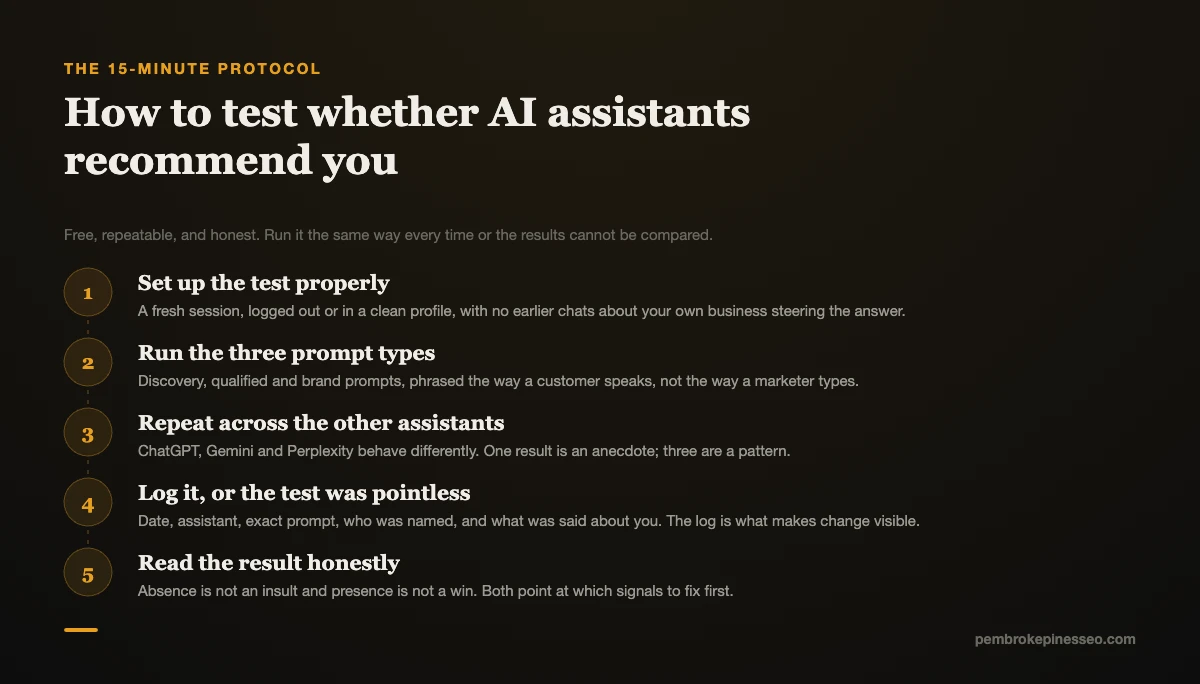
Then measure. Not once, but on a schedule, because answers change.
Stop reading and do this. It is the fastest way to know where you stand, and it costs nothing.
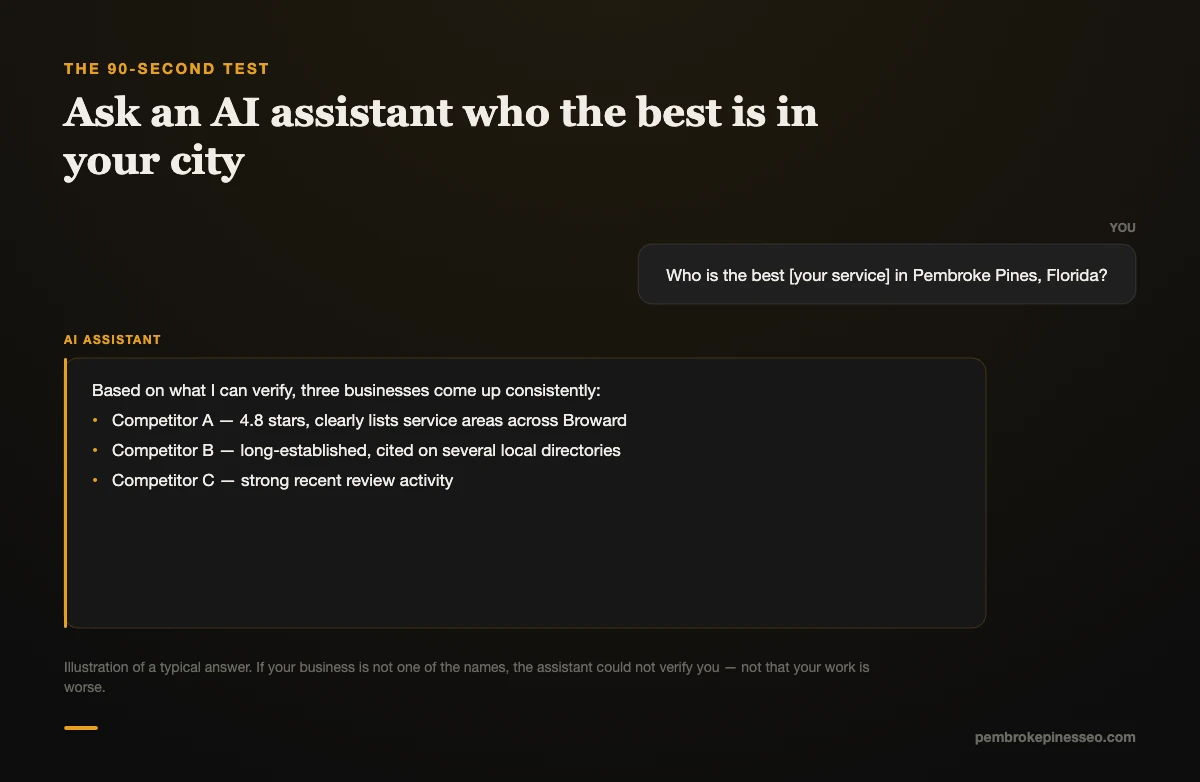
Three outcomes are possible. You were named, in which case check whether the details were accurate. You were not named but competitors were, which means your evidence is thinner than theirs. Or the tool could not answer confidently at all, which usually points to an entity clarity problem at the foundation. Our guide on what to do when ChatGPT does not know your business exists walks through the first outcome in detail, and how to check if ChatGPT recommends your business covers running this test properly over time.
| Actually moves it | Does not move it |
|---|---|
| Consistent facts across your site, GBP, and directories | Adding "Pembroke Pines" to generic sentences |
| Direct answers placed in the first third of a page | Longer articles with the answer buried |
| Published pricing ranges and process detail | A services page that lists service names only |
| Recent reviews with specific language about the work | Review volume from three years ago |
| Third-party mentions you do not control | More pages on your own website |
| Valid LocalBusiness, Service, and FAQPage schema | Keyword density targets |
One honest caution. Nobody controls AI answers. Any agency promising that ChatGPT will recommend you is selling something they cannot deliver, and the same applies to guaranteed Google rankings. What can be done is to build the evidence that makes a recommendation far more likely, and to measure whether it is working.
AI search visibility usually shifts within 60 to 120 days of fixing the underlying signals, though timelines vary by how inconsistent your information was to begin with. Directory and profile corrections propagate fastest. New content and third-party mentions take longer, because they have to be crawled, indexed, and then trusted enough to be cited.
The window itself is the more useful thing to understand. AI systems are still assembling their picture of which local businesses are trustworthy sources in each market. Most businesses in Pembroke Pines, Miramar, Hollywood, and Davie have done nothing about this yet. That is not a reason to panic. It is a reason to move before the answer set in your category settles.
The AI Visibility Snapshot™ scores you across Google, Maps, your website, your competitors and AI tools, then gives you a prioritised 90-day roadmap.
Get My Snapshot →No. AI search visibility builds on local SEO rather than replacing it. The same fundamentals, an accurate Google Business Profile, consistent NAP, real reviews, and a clear website, feed both systems. The difference is the goal: local SEO earns a ranking, while AI visibility earns a mention inside the answer.
No. There is no paid placement inside ChatGPT, Gemini, or Perplexity recommendations for local businesses. Any service claiming to buy you a mention is either misrepresenting what it does or selling ordinary optimization work under a misleading label. Visibility is earned through evidence the systems can verify.
Reviews are one of five signals, not the whole picture. Strong reviews with an incomplete Google Business Profile, an unclear website, or conflicting business details across directories still leave an AI system unable to verify your business confidently. Reviews prove quality. They do not prove identity or relevance.
Not fixed prices. Ranges work, paired with the variables that move them. Cost and pricing questions trigger AI answers at very high rates, and businesses that answer them become the citable source. Businesses that stay silent hand that citation to a competitor who was willing to give a number.
Monthly is a reasonable cadence for a local business. AI answers are not stable the way rankings are, and the same prompt can return different businesses week to week. Track the same set of prompts each time so you are measuring change rather than noise.
AI search visibility is not a new marketing channel you need to add. It is a measurement of whether the work you have already done is legible to the systems your customers now ask for recommendations. Most Broward County businesses that discover they are invisible are not doing anything wrong. Their evidence is simply scattered, inconsistent, or incomplete in ways that were harmless when only Google was reading.
The five signals give you a place to start and an order to work in. Fix identity before content. Fix content before chasing mentions. Measure the AI Signal last, because it is the scoreboard, not the game.
If you would rather see all five scored for your business than work through them alone, that is what the AI Visibility Snapshot does: where you appear across Google, Maps, your website, and AI tools, how you compare to two or three visible competitors in Broward County, and a prioritized 90-day roadmap.
Get My AI Visibility Snapshot → Find out where you’re invisible in Pembroke Pines before your competitors do.
We help businesses across Pembroke Pines, Miramar, Hollywood, Davie, Weston, Cooper City, Hallandale Beach, and greater Broward County improve their visibility in search and AI-powered results.
We help established Pembroke Pines and Broward County businesses become easier to find, understand, trust and recommend across Google, Google Maps and AI tools like ChatGPT, Gemini and Perplexity.
Most owners run this check wrong, panic at the result, and draw the wrong conclusion.
Read article →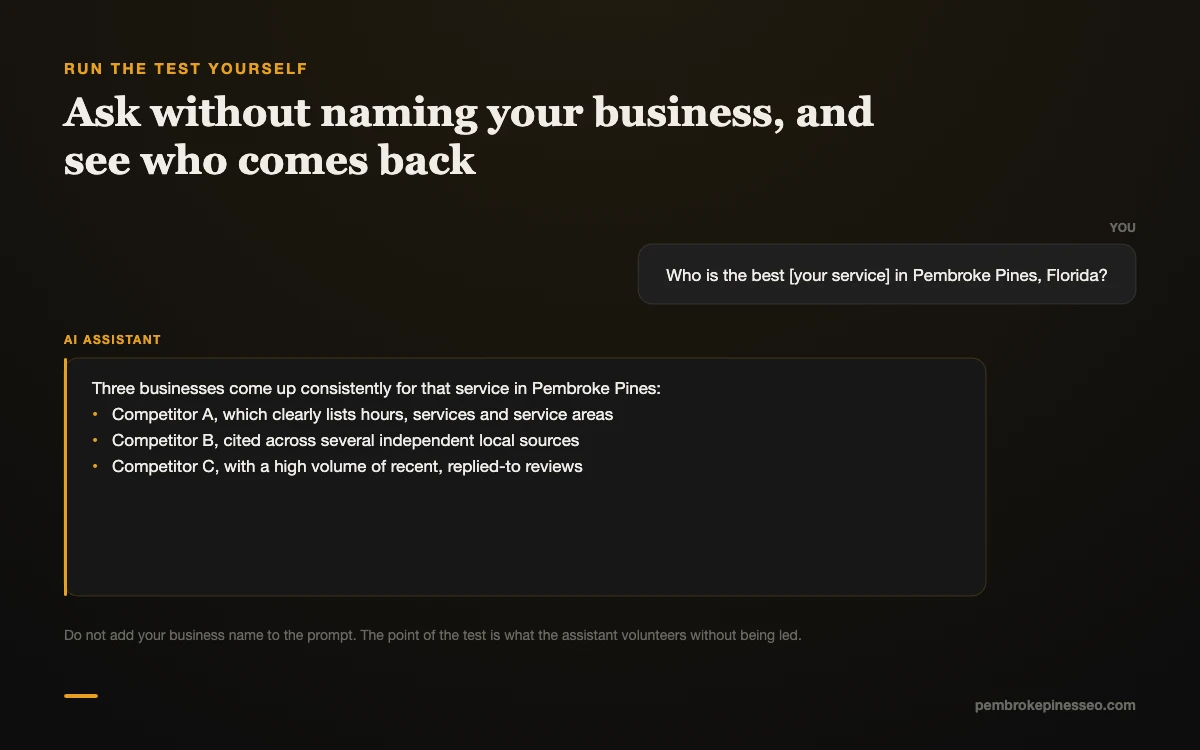
Take out your phone. Open ChatGPT. Type: "Who's the best [your service] in Pembroke Pines, Florida?"
Read article →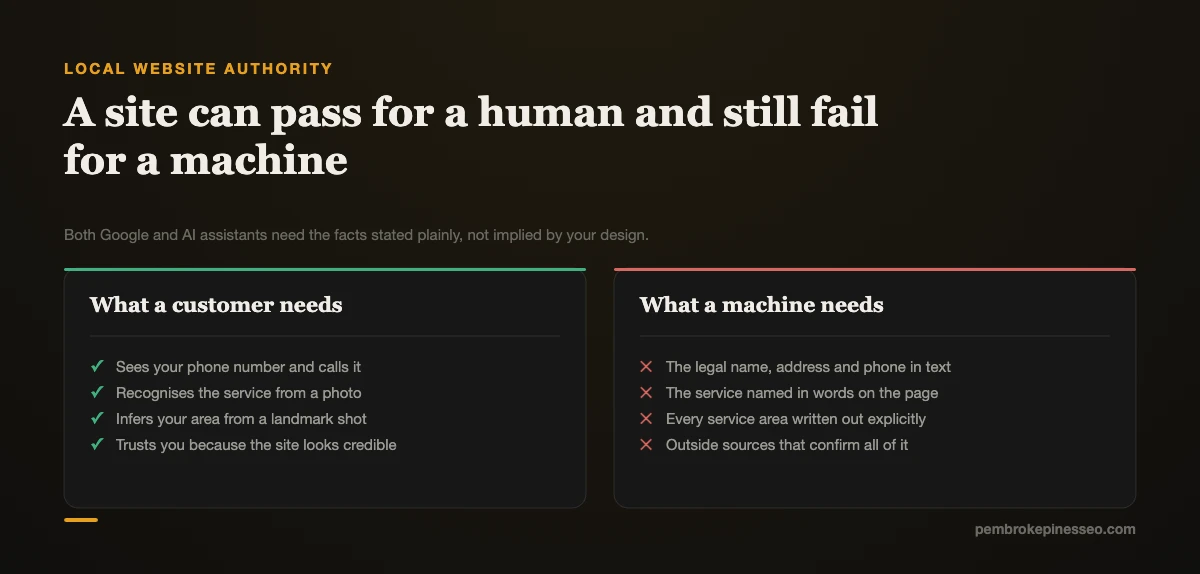
Your website looks fine. A customer can find your phone number, see that you do roofing, and figure out that you are somewhere in Broward County…
Read article →Get a clear, specific picture of your visibility across Google, Maps and AI tools — and the exact roadmap to fix it. Built for Pembroke Pines & Broward County businesses that already do great work.
Get My AI Visibility Snapshot →