Does ChatGPT Know Your Pembroke Pines Business Exists?
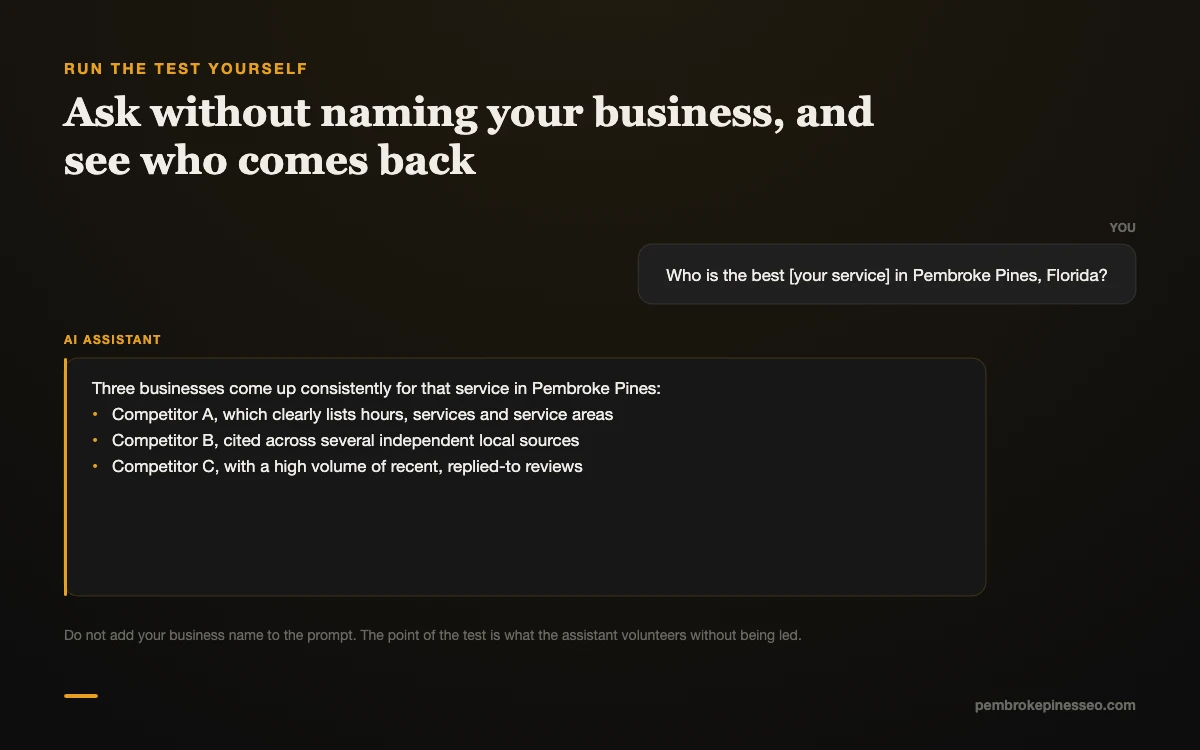
Take out your phone. Open ChatGPT. Type: "Who's the best [your service] in Pembroke Pines, Florida?"
Read article →They open ChatGPT once, type their business name, see something vague come back, and decide either that AI search is hype or that their business is finished. Both readings are wrong, and both come from the same mistake: one prompt is not a test.
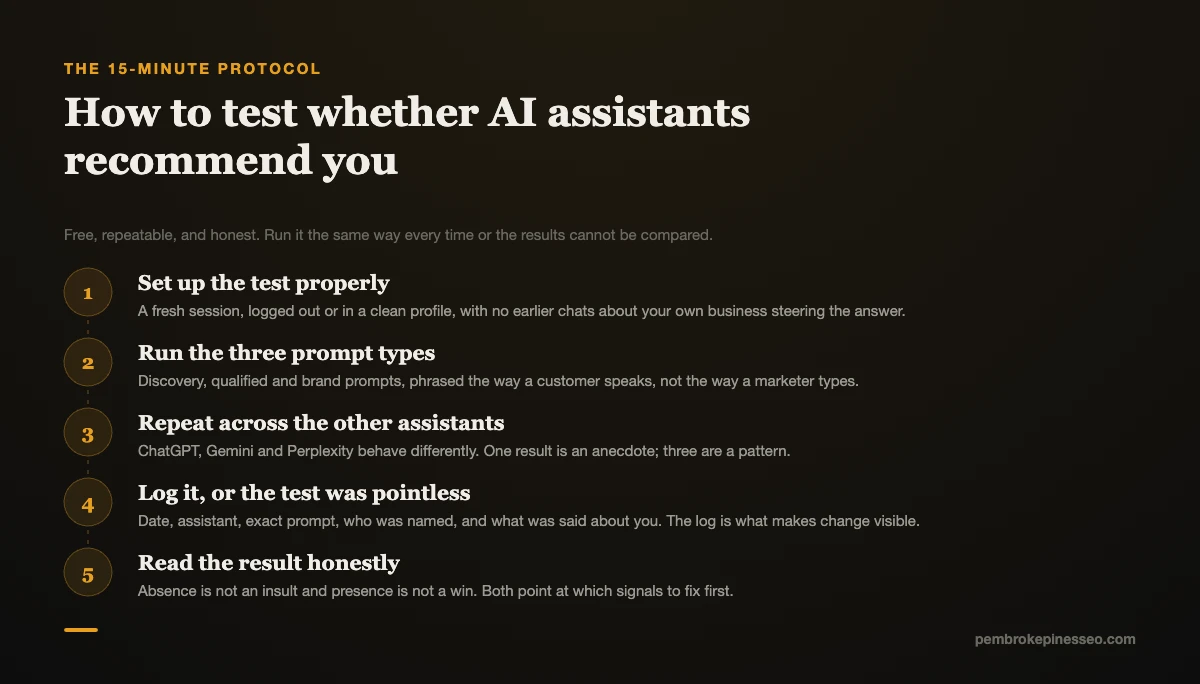
To check whether ChatGPT recommends your business, run three types of prompts in a fresh logged-out session, repeat them across ChatGPT, Gemini, and Perplexity, and log what comes back. It takes about 15 minutes and costs nothing. The result tells you which of four situations you are in, and each one has a different fix.
Here is the protocol, and then the part almost nobody publishes: how to read the answer without overreacting to it.
Absence is the normal result, not a verdict on your business.
SOCi's 2026 Local Visibility Index analyzed more than 350,000 business locations across 2,751 brands and found that ChatGPT recommends roughly 1.2% of local business locations. The same brand set held 35.9% visibility in Google's 3-pack. AI recommendation is roughly 30 times more selective than the map pack.
So if you run this test and you are not there, you are with 98.8% of local businesses. That is not comfort, exactly. It is context. It also means the field in Pembroke Pines, Miramar, and Hollywood is close to empty, and being one of the few businesses in your category that is verifiable right now compounds.
The other number worth holding: use of AI tools for local recommendations jumped from 6% to 45% in a single year, according to BrightLocal's Local Consumer Review Survey 2026. The audience arrived faster than the businesses did.
Three setup rules, and skipping them is why most self-checks produce garbage.
Use a fresh chat, logged out where possible. ChatGPT personalizes based on your history and memory. If you have spent six months discussing your own business in that account, it will name you, and the result is meaningless. Log out, use a private browsing window, or turn memory off.
Do not name your business in the discovery prompts. The whole question is whether ChatGPT volunteers you. Asking "what do you know about my business" answers a different and much easier question: whether the model knows you exist, not whether it puts you on a shortlist.
Run each prompt more than once. These systems are probabilistic and many now fetch the live web per query. The same question can return different businesses on different runs. You are looking for a pattern, not a single pass or fail.
Each one maps to a moment in a real buying decision.
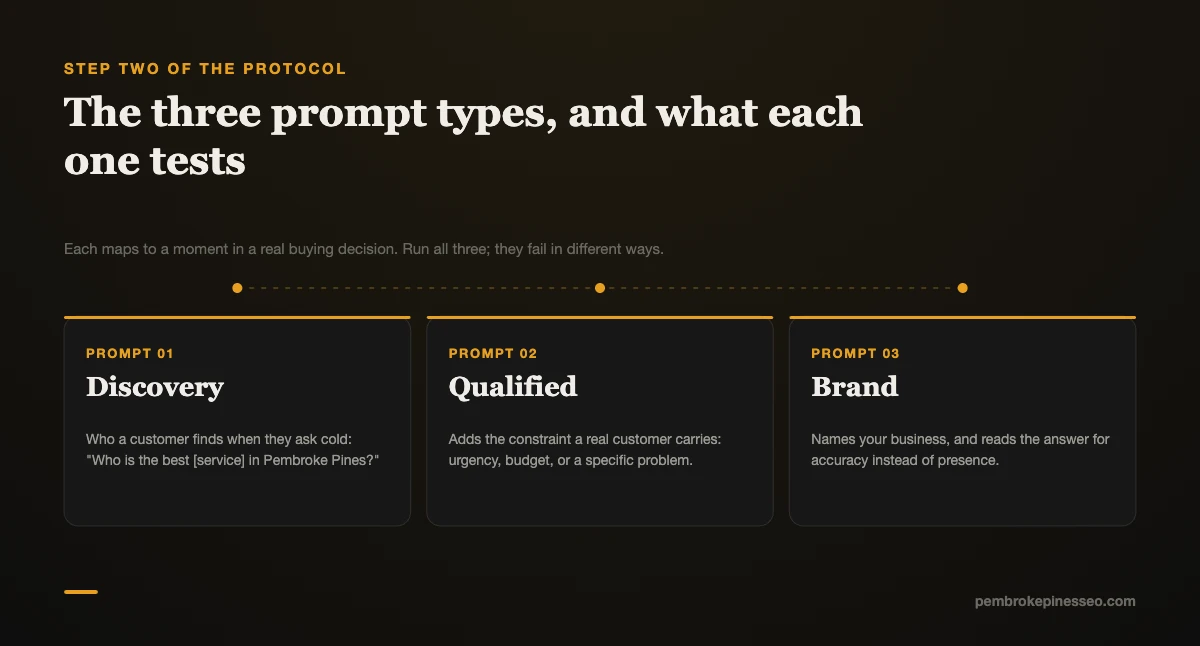
This is the one that matters most. Phrase it the way a customer would speak, not the way a marketer would type.
Add the constraint a real customer carries: urgency, budget, or a specific problem.
Now name yourself, and read the answer for accuracy rather than presence.
That last one is uncomfortable and it is the most useful prompt in the set. It shows you the comparison a prospect is running without you in the room.
Run at least the discovery prompt in Google Gemini, Perplexity, and Google's AI Mode. Expect different answers. That is normal, and the reason is mechanical: these tools read different indexes. Google's AI Overviews and AI Mode use Google's index. ChatGPT's live search leans on Bing. Claude uses Brave.
Which produces a result that confuses owners constantly. You can hold a top-3 map position, rank well on Google, and be entirely absent from ChatGPT, because ChatGPT is not looking at Google. If you have never submitted your site to Bing Webmaster Tools, that is free and takes ten minutes.
The assistants also behave differently in a way worth anticipating. Practitioners running these tests at scale report a consistent pattern: ChatGPT tends to cite its sources but names fewer businesses, Gemini names businesses more freely but leans on existing familiarity, and Perplexity cites most aggressively of the three.
Perplexity's habit of showing its sources makes it the most useful of the three for diagnosis. If it recommends a competitor, click the citations. You are looking directly at what convinced it, which tells you what you are missing.
Appearing in one assistant and no others means your visibility depends on a single retrieval path. Appearing in three or four means the underlying entity is genuinely solid.
Write down, for every prompt: the exact wording, the date, which assistant, whether you appeared, your position in the list, which competitors were named, and any sources cited.
A single run is a snapshot. The value comes from repeating the same prompt set monthly and watching the trend. Three simple numbers give you a real baseline:
| Metric | How to calculate | What it tells you |
|---|---|---|
| Mention rate | Times named ÷ total prompts run | Whether you exist to the system at all |
| Recommendation rate | Times actively recommended ÷ total prompts | Whether you are a candidate or just known |
| Share of voice | Your mention rate vs your top competitor's | Whether the gap is you or the category |
If a competitor appears in 60% of responses and you appear in 10%, that gap is your answer. It is also almost never about who does better work.
This distinction trips up almost everyone, and it changes what you should fix.
A mention is your business being named in the answer. A citation is your website being used as a source for the answer. They are different outcomes and they can happen independently. Your page can be the thing an assistant reads while a competitor is the business it recommends.
Being cited without being mentioned usually means the same thing: your content is useful enough to quote, but no page on your site states plainly what your business is, where it operates, and who it serves in a sentence a model can lift. You have written helpful content and forgotten to identify yourself in it.
Track both columns separately in your log. If citations are climbing and mentions are not, the fix is your service and location pages, not more blog posts.
Four outcomes, four different causes.
| Result | What it means | Where to start |
|---|---|---|
| Named, details correct | Entity is clear and corroborated | Protect it. Keep reviews and listings current |
| Named, details wrong | Known but your information conflicts | NAP audit across every listing |
| Not named, competitors named | Harder to verify than they are | Google Business Profile, then consistency, then reviews |
| No confident answer for anyone | Category is unclaimed locally | Best result on this list. Move now |
The third outcome is the most common in Broward County, and owners take it personally. They should not. The competitor being named is usually not the better operator. They are the business the system can confirm most easily.
The fourth outcome is the one nobody recognizes as good news. If ChatGPT cannot confidently recommend anyone for "best [your trade] in Pembroke Pines," the slot is open.
The AI Visibility Snapshot™ scores you across Google, Maps, your website, your competitors and AI tools, then gives you a prioritised 90-day roadmap.
Get My Snapshot →The prompt test measures whether you are recommended. It does not measure whether anyone clicked through. Since May 2026 you can see some of that for free.
On 13 May 2026, Google added an AI Assistant channel to GA4's Default Channel Group. Recognized referrals from assistants like ChatGPT, Gemini, and Claude are automatically assigned the medium ai-assistant and grouped into their own channel, with no setup required. Most properties saw it populate by early June. To check yours: open Reports, then Acquisition, then Traffic acquisition, and switch the dimension to Session default channel group. See Google's Default Channel Group definitions for the current list of recognized sources.
Three limits matter before you put any number from it in front of anyone.
Treat the number as a floor rather than a total. It is still the cleanest free signal available, and it pairs well with the prompt test: one tells you whether you are named, the other tells you whether being named sends anyone.
Here is the part that changes the strategy for most local businesses.
A Yext study analyzing 6.8 million AI citations across ChatGPT, Gemini, and Perplexity found that 86% of citations came from sources businesses already manage: 44% from first-party websites and 42% from listings and directories. Only about 14% came from third-party sources.
That reframes the whole problem. Most of what an AI assistant says about you comes from places you can edit today. You do not need to influence a mysterious external system. You need to fix your own inputs.
In order:
Fix the pages you already have before writing new ones. A thin site with 40 new blog posts is still a thin site.
Categories deserve a specific mention because that single field costs more visibility than almost anything else on your profile, and it takes ten minutes to fix. We cover that in Google Maps ranking for Pembroke Pines businesses.
Monthly. Same prompts, same wording, logged out, logged in a sheet.
AI answers are not stable the way rankings are. The same question can return different businesses week to week, so a quarterly check gives you noise rather than trend. Monthly with a fixed prompt set gives you something you can actually read.
Paid AI visibility trackers exist and they are genuinely useful for multi-location brands and agencies tracking many markets. For a single-location business in Pembroke Pines, a monthly manual run of 10 prompts covers what you need. Spend the money on fixing the sources instead.
Whether the result will hold. Nobody controls what ChatGPT says, there is no paid placement inside local recommendations, and any service promising that ChatGPT will recommend you is describing an outcome it does not own.
What the test gives you is a baseline and a direction. Run it, write it down, fix the sources, run it again in 30 days. That is the entire method, and it is more than 98% of your competitors in Broward County are doing.
For the wider picture of how this fits with your Google and Maps visibility, start at what AI search visibility means and how the five signals work together. If you have not yet checked whether ChatGPT knows you exist at all, start there instead.
The AI Visibility Snapshot includes this test across ChatGPT, Gemini, and Perplexity, scored alongside your Google visibility, Map Pack presence, website clarity, and trust signals, compared against two or three visible Broward County competitors, with a prioritized 90-day roadmap.
Get My AI Visibility Snapshot →
Find out where you are invisible in Pembroke Pines, before your competitors do.
The fastest way to reach us is the Snapshot request form: tell us your business, your services, and that you serve Pembroke Pines or Broward County, and we will take it from there. We work across Pembroke Pines, Miramar, Hollywood, Davie, Weston and Fort Lauderdale.

We help established Pembroke Pines and Broward County businesses become easier to find, understand, trust and recommend across Google, Google Maps and AI tools like ChatGPT, Gemini and Perplexity.
Take out your phone. Open ChatGPT. Type: "Who's the best [your service] in Pembroke Pines, Florida?"
Read article →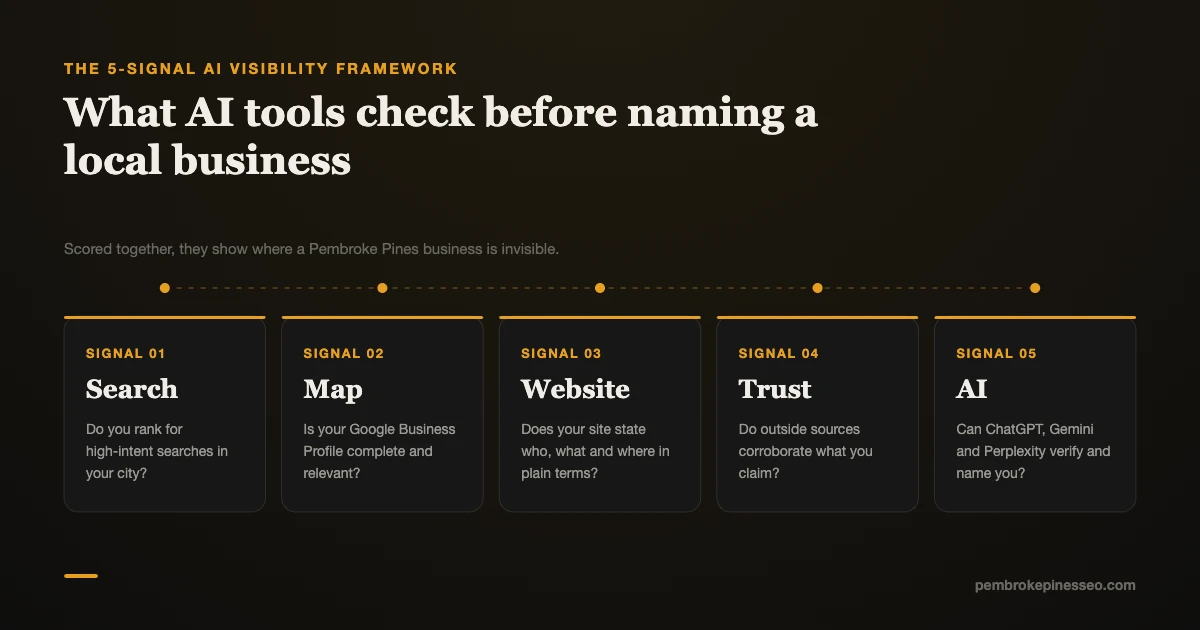
A customer in Pembroke Pines needed your service last Tuesday. They did not open Google. They opened ChatGPT and typed "who's the best [your service]…
Read article →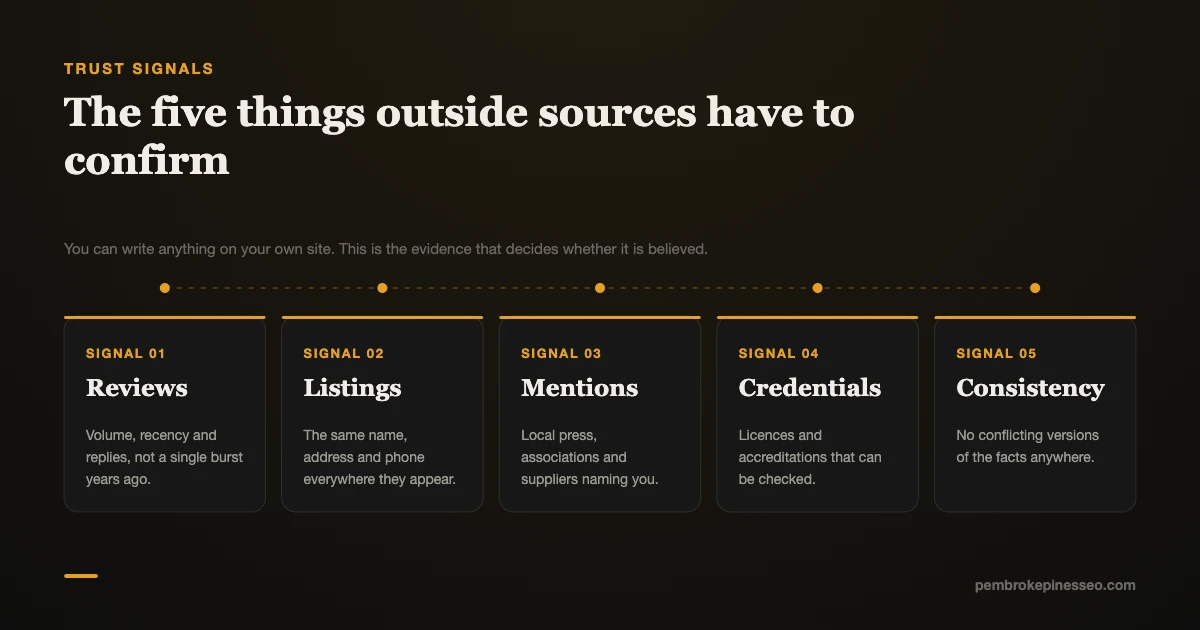
You can write anything you want on your own website. That is exactly why neither Google nor ChatGPT fully believes it.
Read article →Get a clear, specific picture of your visibility across Google, Maps and AI tools — and the exact roadmap to fix it. Built for Pembroke Pines & Broward County businesses that already do great work.
Get My AI Visibility Snapshot →