Service Pages vs Service-Area Pages: The Difference That Matters
A contractor we looked at last year had 43 pages on his website. Thirty-one of them were city pages. Every one was the same 280 words with the city…
Read article →Your website looks fine. A customer can find your phone number, see that you do roofing, and figure out that you are somewhere in Broward County. That is a passing grade for a human visitor.
 Pembroke Pines SEO Company
7 min read
Pembroke Pines SEO Company
7 min read
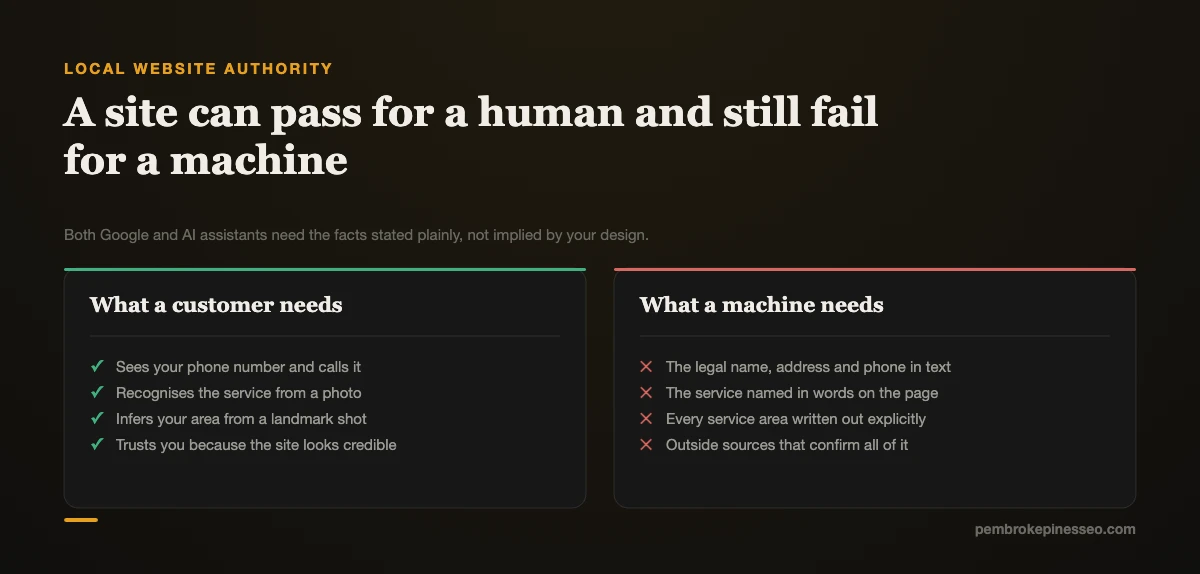
It is a failing grade for a machine.
Local website authority is how clearly your site communicates who you serve, what you do, where you operate, and why you are credible, in a form that both a customer and an automated system can extract without guessing. It is the third of the 5 signals, and it is the one that determines whether Google and AI tools have anything solid to work with when they decide whether to show you.
The uncomfortable part: a site can look professional and still be almost unreadable to the systems that decide who gets recommended.
Local website authority is the combined strength of your site's clarity, structure, and credibility signals for a specific geographic market. It is built from service pages that state what you do, service-area pages that state where, structured data that states your facts in machine-readable form, and internal linking that shows how it all connects.
It is not the same thing as domain authority, which is a third-party score based on backlinks. A small Pembroke Pines site with 40 linking domains can hold strong local authority if the structure and specificity are right.
The websites we see in Broward audits are rarely broken. They are usually vague. One page called Services listing eight things in a bulleted list. One page called Areas We Serve with a list of city names and nothing else. A homepage that says "quality service since 2004" without naming a single city.
Vague is worse than ugly, because there is nothing to extract.
Consider how thin that surface really is. A plumbing company with one Services page has one URL for everything: water heaters, slab leaks, repiping, emergency calls, drain clearing. Every one of those is a different search with different intent and a different customer. One page cannot rank for five intents, and it gives an AI system one shallow paragraph to cite.
The same company with five real service pages has five entry points, five sets of facts, and five chances to be the source of an answer.
Each layer answers a different question. Missing any one of them puts the burden of inference on a system that will usually just go find a business it does not have to infer about.
| Layer | Answers | Built from |
|---|---|---|
| Service clarity | What do you do? | One page per real service, not a bulleted list |
| Geographic clarity | Where do you do it? | Service-area pages with genuine local content |
| Credibility | Why should anyone believe you? | Licenses, real photos, named team, case detail |
| Machine readability | Can a system parse this? | Semantic HTML, schema markup, internal links |
One page per service you actually want to sell. Each page states the problem the customer has, what the work involves, what it typically costs in ranges, how long it takes, and what happens next.
Pricing is where most local businesses stop, and it costs them. Cost queries trigger AI answers at very high rates, and a page that gives a range with the variables that move it becomes the citable source. Square footage, materials, permit requirements, urgency. Silence hands the citation to whoever was willing to publish a number.
Naming cities is not the same as covering them. A page that says "we also serve Miramar, Hollywood, Davie and Weston" in a footer is not geographic clarity. It is a list.
The distinction between service pages and area pages, and the doorway-page line you should not cross, is covered in detail in service pages vs service-area pages.
This is where E-E-A-T stops being an acronym and becomes concrete. Your Florida license number on the page. Photos of your actual trucks and actual finished work, not stock images of smiling professionals. A named person with a bio, not "our team of experts." Specific project detail: a re-roof in Chapel Trail, a repipe in Silver Lakes, described without naming the customer.
Google's vision systems analyze photos as part of assessing whether a page is genuinely local. Generic stock imagery reads as low-context boilerplate. Your own photos of Broward jobs read as evidence.
Real headings, real lists, real tables. Not text styled to look like a heading inside a div. Not a comparison rendered as an image. Large language models extract structured chunks, and a styled div is not a chunk.
Placement matters as much as structure. Kevin Indig's analysis of 1.2 million ChatGPT responses found that 44.2% of citations came from the first 30% of a page. Burying the direct answer under 600 words of introduction removes it from the zone that gets cited most.
Then schema. LocalBusiness with your exact NAP and geo coordinates, Service for each service page, FAQPage where you have genuine questions and answers, BreadcrumbList for structure. Validate every block before publishing, because invalid JSON-LD is worse than none at all. Google's Rich Results Test takes 30 seconds.
Orphan pages are the most common and most preventable local SEO failure. A page that exists, is technically live, and is linked from nowhere.
It happens constantly with service-area pages, because they get built in a batch, added to a sitemap, and never linked from anything a person would actually navigate. Search engines find them slowly or not at all. AI crawlers find them the same way.
Three rules fix it permanently. Every page links up to its parent hub. Every page links sideways to two genuinely related pages. Every new page gets an inbound link from two existing pages within a week of publishing. Keep the record somewhere you will actually check.
The AI Visibility Snapshot™ scores you across Google, Maps, your website, your competitors and AI tools, then gives you a prioritised 90-day roadmap.
Get My Snapshot →Website clarity feeds AI visibility directly, because AI systems need to define your business before they can recommend it. Semrush describes the requirements as entity clarity, relevance, and corroboration. Your website is where entity clarity either exists or does not.
But it is only part of the picture, and this is the part that surprises owners. Research from Omniscient Digital analyzing more than 23,000 citations found that a brand's own content accounted for only about 23% of citations on branded queries. The other 77% came from sources the brand does not control.
Your website is evidence. It is not proof. That distinction is why the Trust Signal work sits alongside this and not after it.
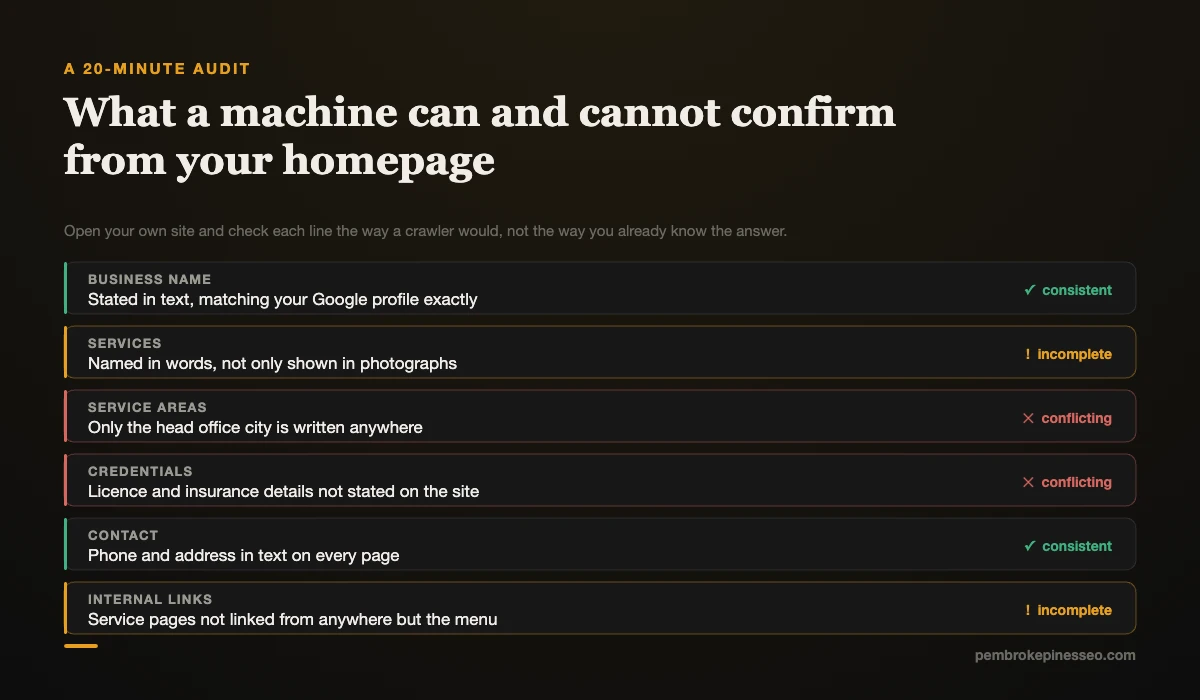
Open your own site on your phone, the way your customers do, and answer these honestly.
Most Broward sites fail four of these seven. That is not a criticism of the business. It is a description of what happens when a site is built once and never revisited while the systems reading it changed underneath.
Fix identity before content. Fix content before chasing links. Specifically: make sure the homepage names what you do and where, give each real service its own page, publish one price range, replace the stock photos with your own, add LocalBusiness and Service schema, then link everything properly.
That sequence takes a few weeks of steady work and it lifts the Search Signal, the Website Signal, and the AI Signal at once, because all three are reading the same pages.
If you would rather know which of the seven checks above your site is failing, and what it is costing you in Pembroke Pines specifically, the AI Visibility Snapshot includes a website authority review alongside your Google, Maps, and AI visibility.
Get My AI Visibility Snapshot → Find out where you're invisible in Pembroke Pines before your competitors do.
We help businesses across Pembroke Pines, Miramar, Hollywood, Davie, Weston, Cooper City, Hallandale Beach, and greater Broward County improve their visibility in search and AI-powered results.
We help established Pembroke Pines and Broward County businesses become easier to find, understand, trust and recommend across Google, Google Maps and AI tools like ChatGPT, Gemini and Perplexity.
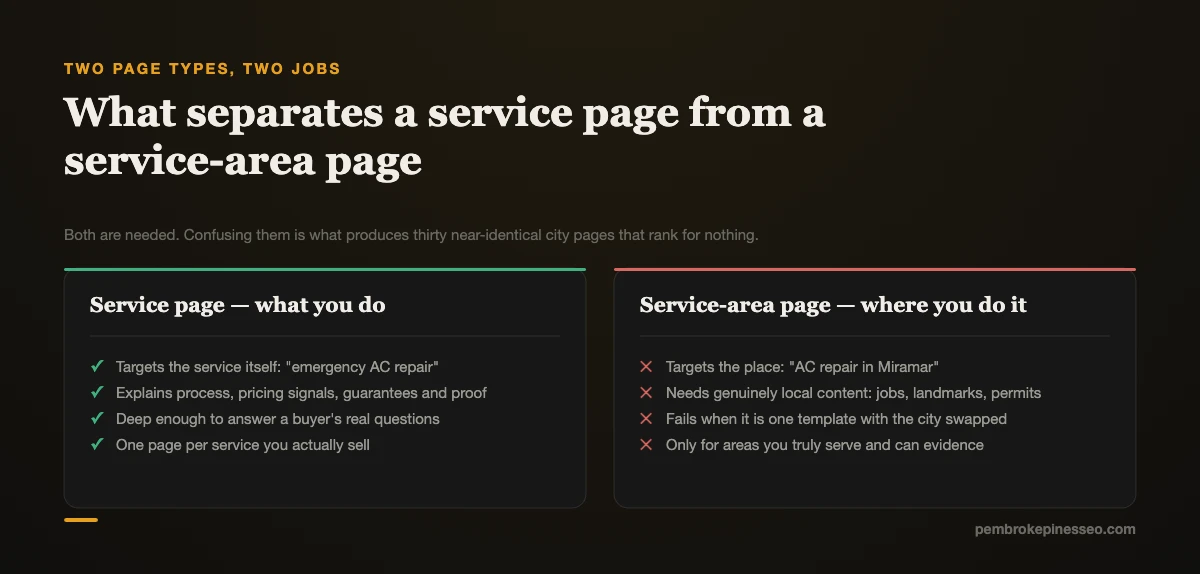
A contractor we looked at last year had 43 pages on his website. Thirty-one of them were city pages. Every one was the same 280 words with the city…
Read article →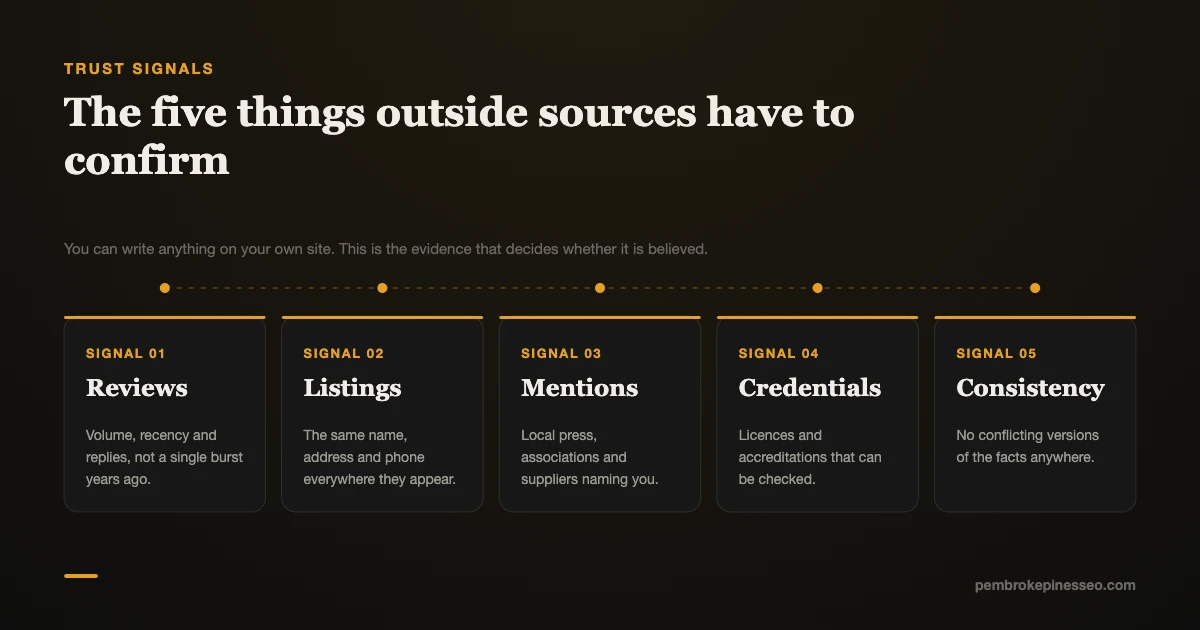
You can write anything you want on your own website. That is exactly why neither Google nor ChatGPT fully believes it.
Read article →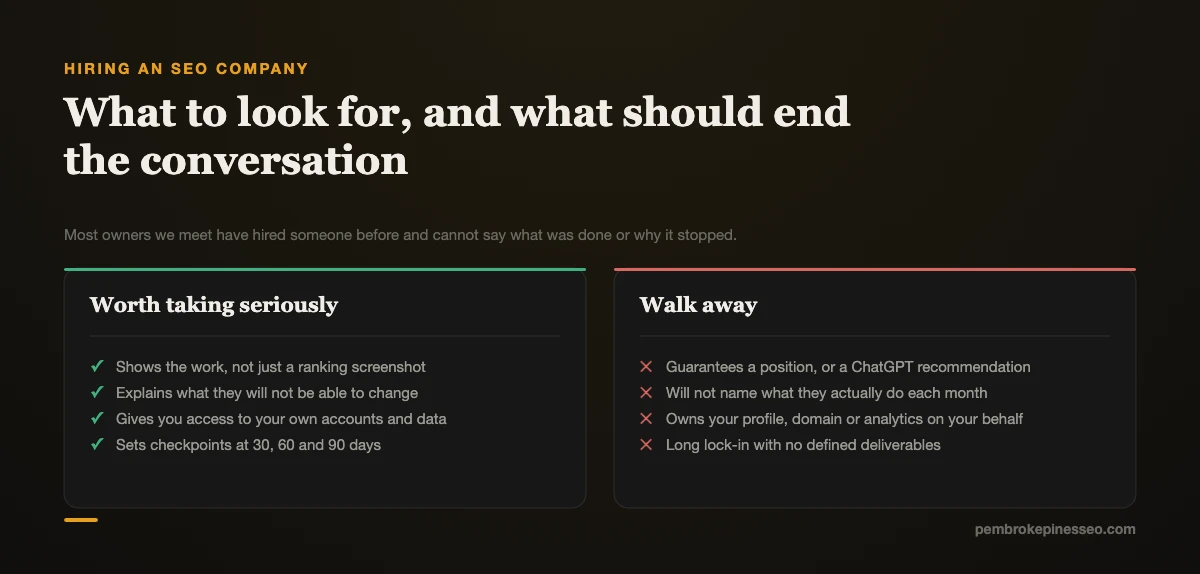
Most Broward business owners we talk to have hired an SEO company before. A meaningful number of them cannot say what that company did, what it cost…
Read article →Get a clear, specific picture of your visibility across Google, Maps and AI tools — and the exact roadmap to fix it. Built for Pembroke Pines & Broward County businesses that already do great work.
Get My AI Visibility Snapshot →