Google Maps Ranking for Pembroke Pines Businesses
You have been in business for 18 years. Your reviews are better than the company three miles east. And when someone standing in a Pembroke Pines…
Read article →Nothing is broken. You were both looking at accurate results. You were just standing in different places.
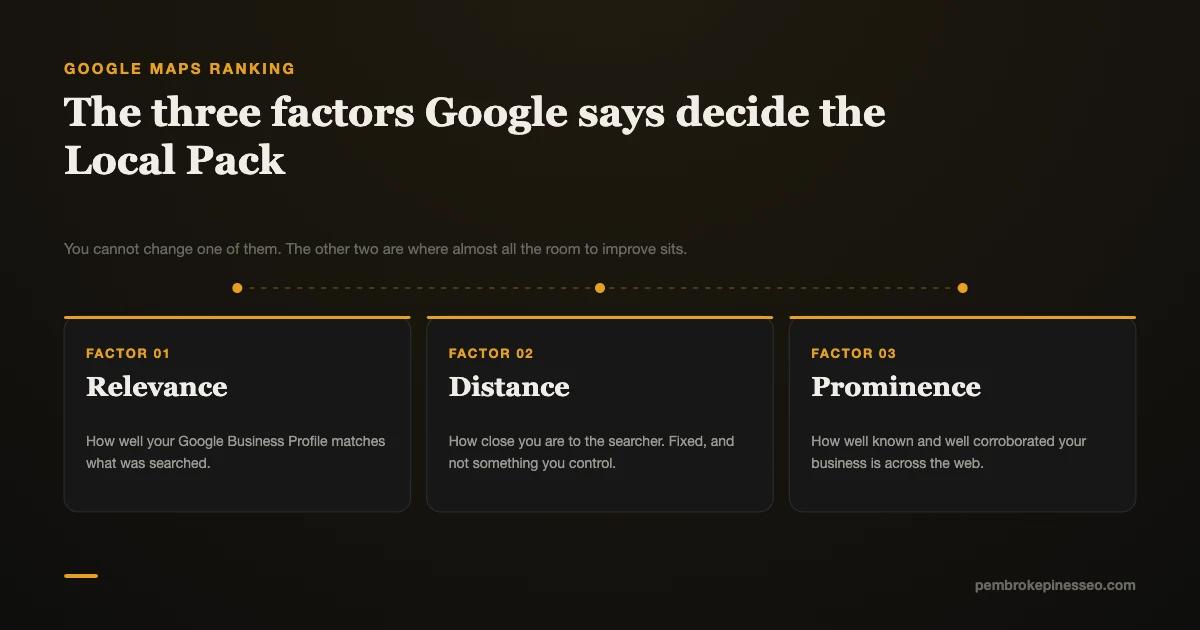
Your Google Maps ranking changes by location because distance between the searcher and your business is one of the three factors Google uses to build local results, and it is recalculated for every single search. Google's own documentation lists relevance, distance and prominence as the primary factors, and confirms that when a customer does not share their location, Google uses what it knows about where they are.
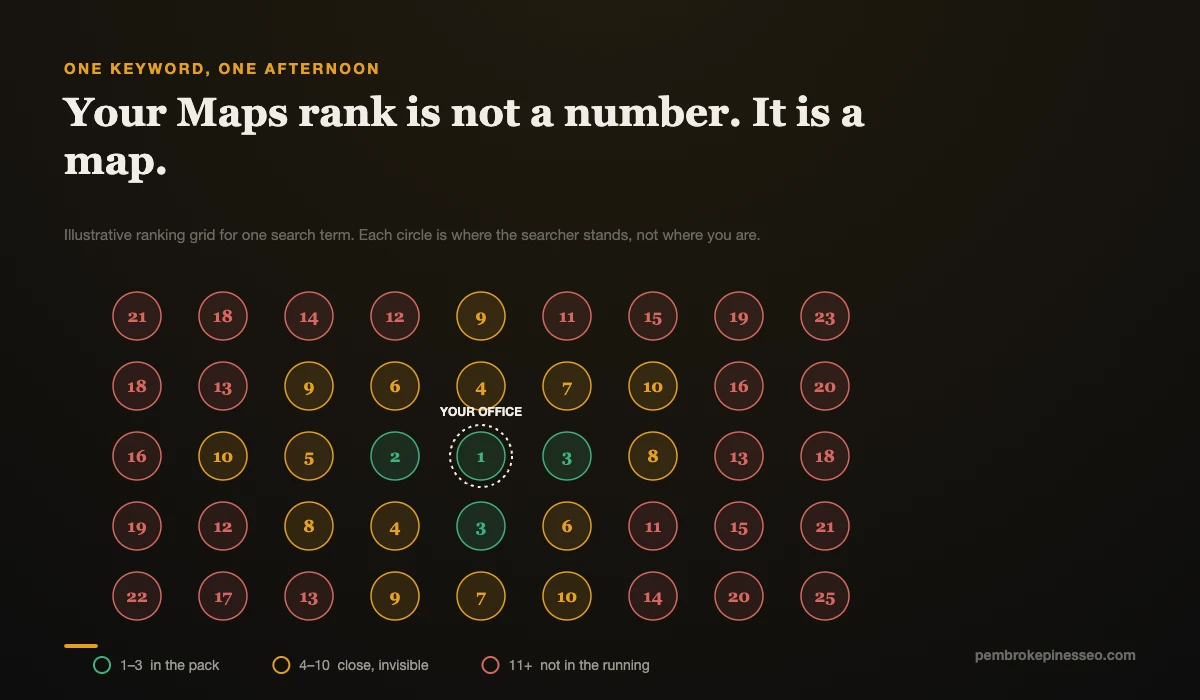
The consequence catches almost every owner off guard: you do not have a Google Maps ranking. You have a different ranking at every point on the map, recalculated in real time, for every query, from every position.
A single number was never on offer. The thing you are actually trying to see is a map of numbers.
Here is the uncomfortable part. When you search your own category from your own business, you are standing at distance zero from your own listing. That is the single most favorable position that exists, and it is a position essentially none of your customers occupy.
So the check most owners run, repeatedly, and use to reassure themselves, is the one check guaranteed to overstate their visibility.
It also works in reverse and causes real damage. Owners who see themselves ranked first from the office conclude their local SEO is handled and stop investing, while their actual customer base three miles out never sees them. Others panic at a competitor's result without realizing the competitor was searching from somewhere else entirely.
Neither result is wrong. Both are incomplete.
This is the part almost nobody explains, and it changes how much of this problem you can actually solve.
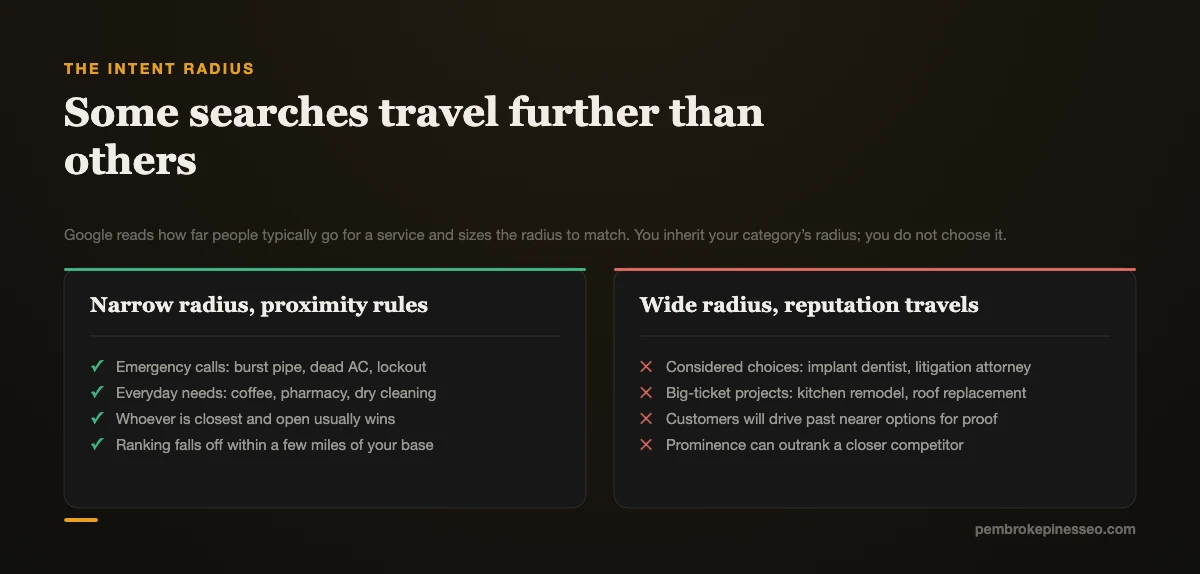
Google does not apply the same geographic radius to every query. It interprets intent first, then decides how far afield to look.
Someone searching "coffee" is assumed to want a cafe within a few blocks, so Google returns a tight neighborhood cluster. Someone searching "sports stadium" is assumed to be willing to drive, so Google casts a much wider net across the whole metro area. Both are local searches. The radius is completely different, and that difference comes from Google's read of the intent rather than from anything either business did. Search Engine Land's guide to proximity bias in local search works through this with real ranking-grid examples.
Sort your own services into two buckets, because they behave differently.
Tight-radius services are ones customers expect to find nearby and will not travel for: emergency plumbing, a walk-in clinic, a quick oil change, lunch. Proximity dominates. Your realistic footprint is smaller than you want it to be.
Wide-radius services are ones customers will drive for because the decision matters more than the convenience: a specialist dentist, a personal injury attorney, a roofing contractor for a full replacement, a wedding venue. Google knows people travel for these, so relevance and prominence carry more weight and your reachable radius is genuinely larger.
Most Broward service businesses sell both. An HVAC company doing a same-day no-cooling call is a tight-radius business. The same company selling a full system replacement is a wide-radius business. That is one company with two completely different visibility problems, and treating them as one is why the effort feels like it goes nowhere.
Twenty minutes and a phone gets you most of the way.
That last column is where the real information sits. If the same competitor appears everywhere including your own doorstep, the issue is not distance and you should look at the eligibility and scoring diagnostic instead. If different businesses appear at each stop and each one is simply the closest, you are looking at ordinary proximity behavior and there is no fault to fix.
Geogrid tools automate this. They run the same search from dozens or hundreds of GPS coordinates and return a heat map, which is faster and more systematic than driving around. Whitespark's local ranking grids are a well-established option and several others exist.
They are genuinely useful if you manage multiple locations, or if you need to show someone a picture. For a single-location business in Pembroke Pines checking one or two core services, the manual version tells you the same thing for nothing. Buy the tool when the driving becomes the bottleneck, not before.
You cannot move the searcher and you probably cannot move your building. What you can do is build enough relevance and prominence that Google is willing to show you to people who are not closest.
Be realistic about the ceiling. In a dense market, proximity will keep winning for generic high-competition terms no matter what you do. What follows expands the radius. It does not remove distance from the equation.
This is the most underused lever available to a local business.
Your radius for a generic category term is narrow because dozens of businesses match it. Your radius for something specific can be dramatically wider, because far fewer businesses match and Google has to reach further to fill the results.
A roofer competing on "roofer" in Broward is fighting proximity alone. The same roofer competing on tile roof replacement, or on insurance claim work, or on a specific material, is competing on relevance, where being the best match matters more than being the nearest.
Find the thing you genuinely do better or more often than the businesses around you, then make sure it appears in your Business Profile services, on your website, and in the language your customers use about you.
Review text feeds Google's understanding of what your business is associated with, including places.
Google surfaces this visibly. On many Business Profiles, the reviews section shows topic tabs generated from recurring words in customer reviews, with a count next to each. Those tabs are a direct readout of what Google thinks you are known for.
You cannot script reviews, and you should never try. You can shape what you ask about. A request that says "if you have a minute, it would help if you mentioned the work we did and the area you're in" produces different reviews than "please leave us a review." Over dozens of reviews, that accumulates into an association between your business and specific Broward neighborhoods.
Directory listings confirm your details. Mentions on local blogs, community sites, sponsor pages, event listings and local news do something different: they tie your business to a place in a context Google reads as genuine rather than submitted.
Sponsoring a youth league in Miramar, appearing on a Broward business podcast, or getting listed on a community event page all build the association between your business name and that area. This is slow work and it compounds. Our guide to trust signals that Google and AI tools both verify covers the wider picture.
Schema markup, for this purpose. LocalBusiness markup is worth having for clarity and consistency, but Whitespark's testing found no evidence it affects local rank. Add it, keep it accurate, do not expect it to widen your radius.
Inflating your service area radius. Setting the widest possible area in your Business Profile does not extend your reach, and claiming areas you do not genuinely serve has become a suspension trigger.
Keyword-stuffing your business name. It works briefly, it violates Google's guidelines, and profiles get suspended for it.
Fake or virtual addresses. Same category of idea, much worse consequences.
The AI Visibility Snapshot™ scores you across Google, Maps, your website, your competitors and AI tools, then gives you a prioritised 90-day roadmap.
Get My Snapshot →Once you can see your actual map, you have a business decision rather than an SEO problem.
Broward makes this sharper than most markets. Pembroke Pines, Miramar, Cooper City, Davie, Weston and Hollywood sit within a short drive of one another, which means a single address sits inside a crowded field of competitors who all have proximity on their side somewhere.
So ask which cities you can realistically win organically, and which ones you cannot. For the ones you can, invest in relevance and prominence and expect it to compound. For the ones where you are simply too far and the field is dense, organic map visibility is the wrong tool, and Local Service Ads or paid search are the honest answer for that territory.
That is a more useful conclusion than "improve your local SEO," and it stops you spending a year trying to win a city where geometry was always going to beat you. The geographic realities across our service area are covered in where we work: local search across Pembroke Pines and Broward County.
Run the drive test before concluding anything. Proximity is the explanation when your position degrades smoothly as you move away and the businesses replacing you are the ones nearest to each stop.
It is not the explanation when you are missing even at your own address, when one competitor outranks you everywhere including next door, or when your position collapsed overnight without you moving. Those are eligibility, relevance or profile problems, and they are covered in the Google Maps ranking hub.
There is no fixed distance, and anyone quoting one is guessing. The radius depends on your category, how many competitors match the query nearby, and how Google interprets the intent. A rural business can be the only match for many miles. A Pembroke Pines contractor competing with 40 others may see visibility fall off within two or three miles for generic terms.
Sometimes, for wide-radius services, with strong enough relevance and prominence. Rarely for generic tight-radius terms against businesses physically located there. Build genuine service-area content and local associations rather than a page that swaps the city name, which reads as a doorway page to Google and to customers.
It removes personalization from your account history, which helps, but it does not remove location. Your device still reports where you are, so an incognito search from your office is still a search from distance zero. Changing location is what matters, not changing browser mode.
Location precision differs. Mobile devices supply GPS coordinates accurate to a few meters. Desktop typically relies on IP-based geolocation, which is often only accurate to city level. Two people standing beside each other can see different results if one is on a laptop and one is on a phone.
Almost never worth it for search alone, and the disruption outweighs the gain for most established businesses. Relevance, prominence and paid coverage for outlying territory are the practical levers. Location matters most for a business that has not signed a lease yet.
Do the drive test this week. It costs nothing, it takes twenty minutes, and it will tell you more about your real visibility than any report you have been sent.
If you would rather see it measured properly, including how you compare to two or three visible Broward County competitors across the markets you care about, and where AI tools place you alongside the map pack, that is what the AI Visibility Snapshot covers.
Get My AI Visibility Snapshot →
Find out where you are invisible in Pembroke Pines, before your competitors do.
The fastest way to reach us is the Snapshot request form: tell us your business, your services, and that you serve Pembroke Pines or Broward County, and we will take it from there. We work across Pembroke Pines, Miramar, Hollywood, Davie, Weston and Fort Lauderdale.

We help established Pembroke Pines and Broward County businesses become easier to find, understand, trust and recommend across Google, Google Maps and AI tools like ChatGPT, Gemini and Perplexity.
You have been in business for 18 years. Your reviews are better than the company three miles east. And when someone standing in a Pembroke Pines…
Read article →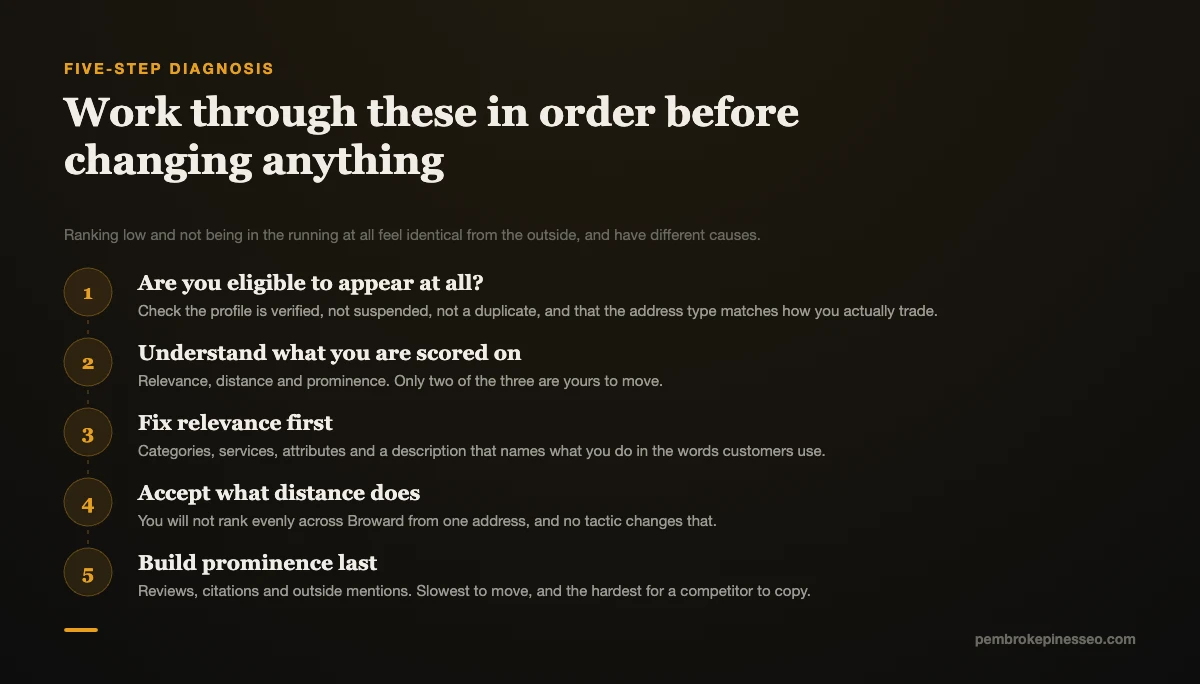
There is a version of this problem where you are ranked low, and a version where you are not in the running at all. They feel identical from the…
Read article →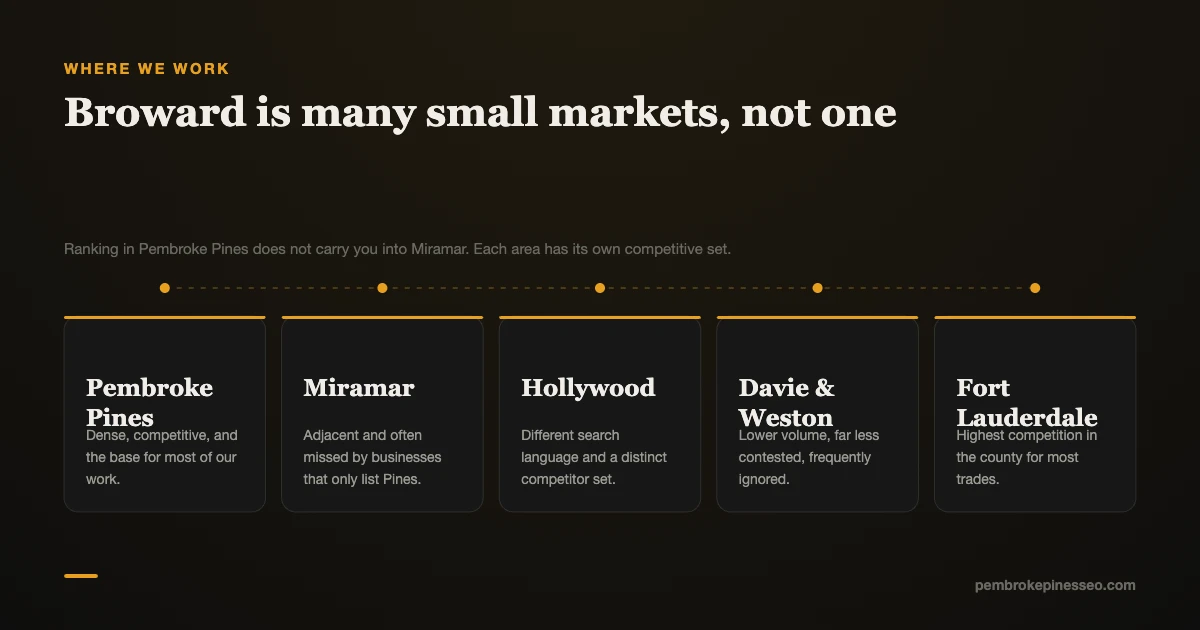
Broward County is unusual, and it changes how local search works here.
Read article →Get a clear, specific picture of your visibility across Google, Maps and AI tools — and the exact roadmap to fix it. Built for Pembroke Pines & Broward County businesses that already do great work.
Get My AI Visibility Snapshot →