How to Hire an SEO Company in Pembroke Pines
Most Broward business owners we talk to have hired an SEO company before. A meaningful number of them cannot say what that company did, what it cost…
Read article →If you've gotten three quotes for local SEO and they range from $400 a month to $4,000, you're not doing anything wrong. The quotes really are that far apart, and every pricing guide on the internet seems to quote a different "average." This guide explains what local SEO actually costs in South Florida in 2026, why the numbers vary so much, what you're really paying for, and how to tell a fair price from a bad deal.
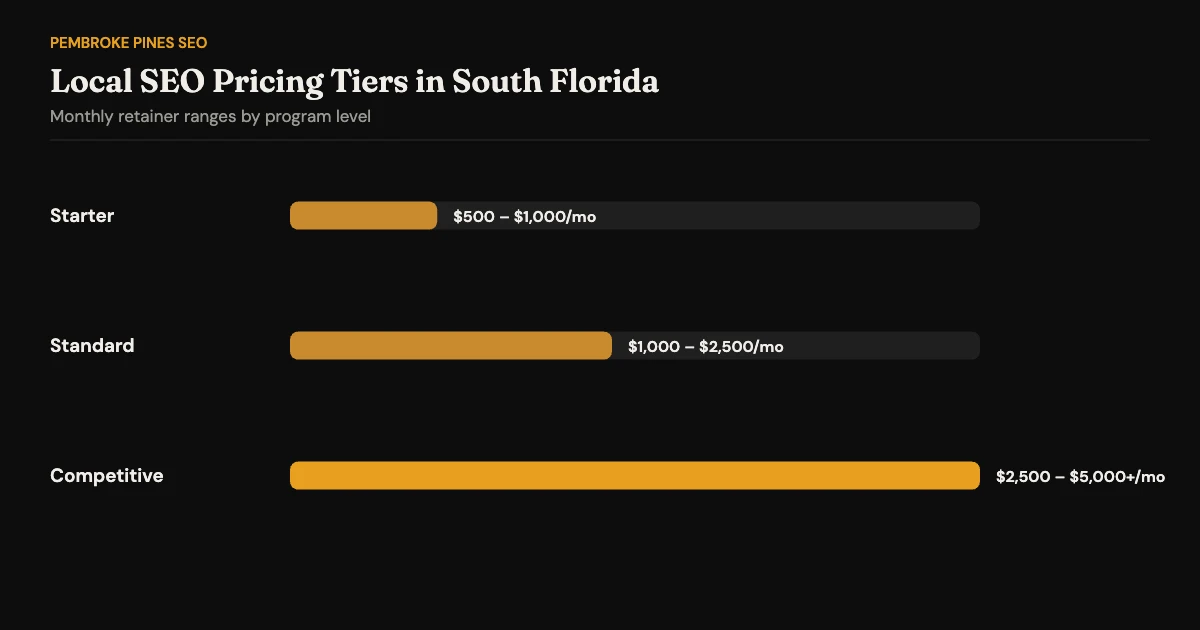
The short answer: most small businesses in South Florida pay $500 to $2,500 per month for legitimate ongoing local SEO, with competitive trades and multi-location programs running $2,500 to $5,000 or more. That range comes from 2026 industry surveys, not from us, and the rest of this guide explains what sits behind it.
Shopping for help right now? Request a free AI Visibility Snapshot. It scores your business across Google, Maps, and AI tools like ChatGPT and gives you a 90-day roadmap, so any quote you get can be judged against what you actually need.
Before the numbers, you need to understand why they conflict. One guide says most small businesses pay $300 to $1,500 a month. Another says $1,500 to $3,500. Both can be honest. They're describing different amounts of labor.
Local SEO is skilled work billed by the hour, then packaged as a monthly retainer. Industry surveys put the average SEO hourly rate around $111 an hour in 2026, with most providers billing between $75 and $200. So when you see a $600 monthly retainer, you're looking at roughly four to six hours of specialist time a month. A $2,500 retainer is more like fifteen to twenty hours, plus tools, plus reporting.
That's the whole mystery. A cheap package isn't a discount on the same work. It's less work. Once you read every price as "how many hours of expert labor is this," the quotes start making sense, and the absurdly cheap ones start looking absurd for the right reason.
Most providers sell SEO in one of five ways. Here's what each one means and when it fits.
| Model | Typical cost (2026 industry ranges) | Best for | Watch out for |
|---|---|---|---|
| Monthly retainer | $500 to $5,000+/mo | Ongoing growth; the standard for a reason | Needs a multi-month commitment to work |
| Tiered packages | $500 to $3,000/mo by tier | Small businesses that want predictable scope | The tier may not match what you actually need |
| One-time project | $500 to $5,000; audits $2,000 to $10,000 | A defined fix: audit, cleanup, site rebuild | SEO decays without maintenance afterward |
| Hourly consulting | $75 to $200/hr | In-house teams that need expert guidance | Expensive at scale; no execution included |
| Pay for performance | Base fee plus bonuses per ranking | Sounds appealing | Avoid. Reputable sources consistently warn against it |
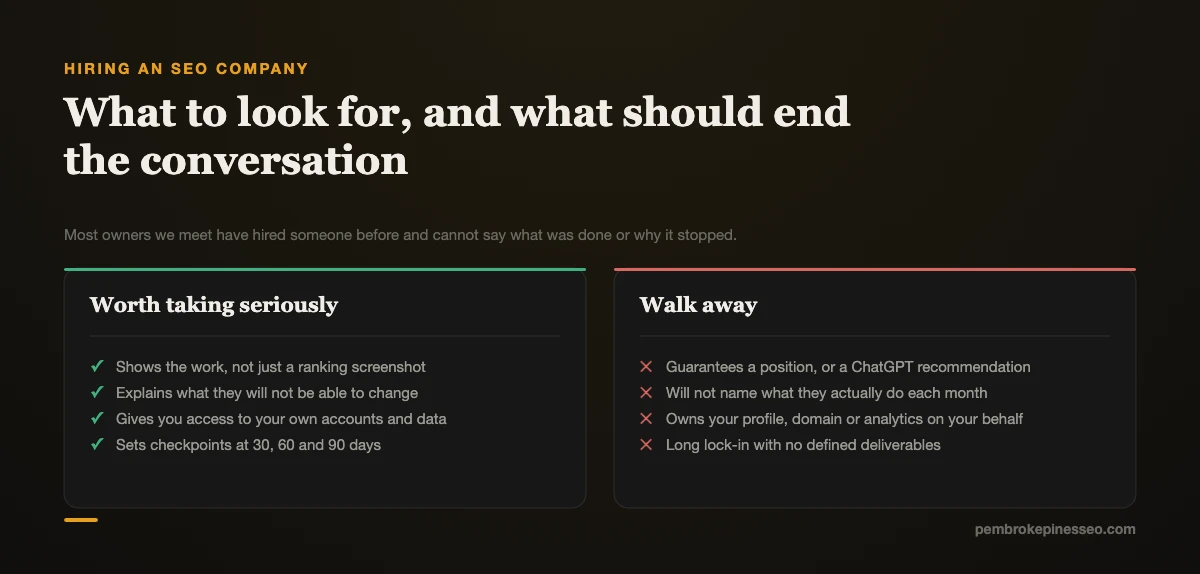
A note on that last row, because it comes up constantly: pay-for-performance SEO sounds like aligned incentives, but it rewards the agency for ranking easy, irrelevant keywords and encourages risky shortcuts. Google itself says no one can guarantee rankings. If the pricing model depends on a promise Google says is impossible, walk away.
Prices mean nothing without deliverables. Here's what the tiers typically contain, based on published 2026 package breakdowns across the industry.
The pattern: you're not choosing between good and bad SEO. You're choosing how much labor goes into your market each month. A $700 package can be perfectly honest, and a $3,000 package can be a bad deal, depending on what's inside and what your market demands.
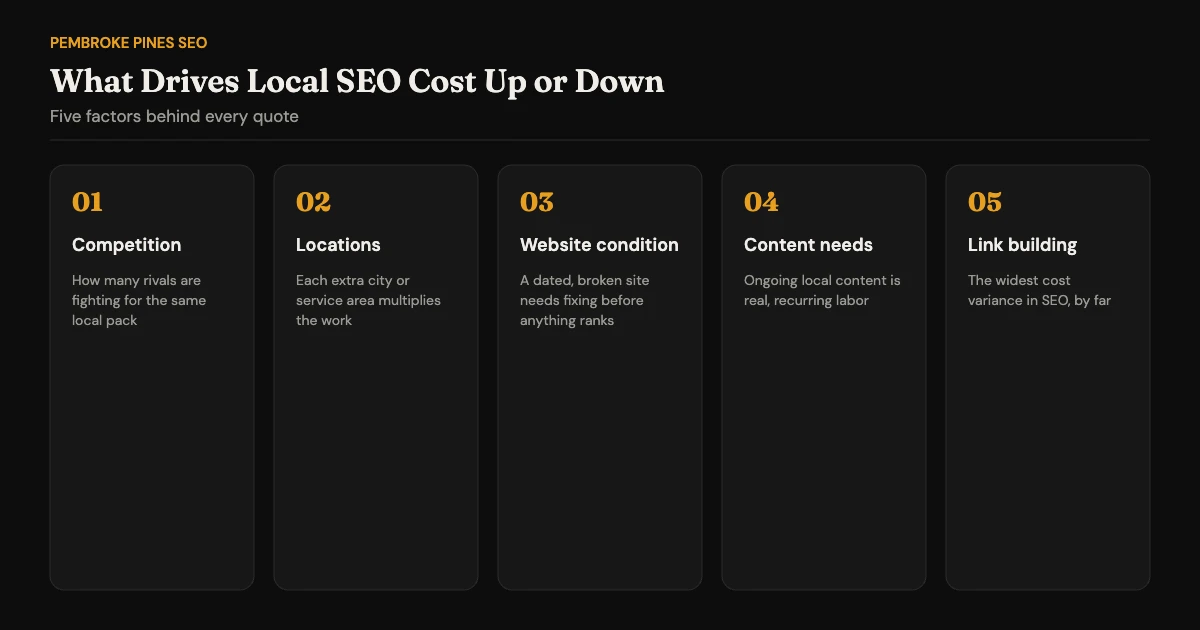
Six factors move the number more than anything else.
South Florida isn't an average market, and pricing here reflects that. A few structural facts:
None of this means South Florida businesses overpay. It means the market demands more labor than a quiet suburb, and honest quotes reflect that.
Almost every legitimate program has one, and almost nobody advertises it. Expect a one-time setup or onboarding fee, typically $250 to $1,000, covering the initial audit, profile overhaul, citation cleanup, and analytics setup. Some agencies roll it into the first months; some itemize it.
This isn't a scam. The first month of real SEO is the most labor-intensive: research, fixes, and foundation work before the compounding starts. What *is* a red flag is a setup fee you only discover after signing, or a setup fee with no explanation of what it buys. Ask for the itemized list. A good agency has one ready.
Monthly prices hide the real number. Do the year-one math before you sign anything:
Now compare that against the alternative of hiring: the median in-house SEO salary in the US runs around $54,000 a year, before tools, benefits, and the fact that one person can't cover strategy, content, technical, and outreach alone. For most small businesses, the retainer is cheaper than the employee. That's the honest economic case, and it's why the retainer model dominates the industry.
Then do the break-even math for your business. If your average customer is worth $150 in gross profit and you're spending $1,557 a month, you need about eleven new customers a month from organic search to break even. If your average customer is worth $2,000, you need one. High-value trades break even fast; low-margin, low-ticket businesses need volume. Any agency that can't walk through this math with you isn't thinking about your business.
The other question behind every pricing conversation: wouldn't ads be simpler? Sometimes. Here's the honest tradeoff.
Ads deliver calls immediately and stop the day you stop paying. In competitive South Florida trades, those clicks are expensive, and the price only goes one direction over time. SEO takes months to build, but its cost per lead falls as content compounds. Industry analyses consistently show SEO's cost per lead dropping 50 to 70 percent by month twelve to eighteen, while paid costs stay flat or rise.
There's also a durability difference worth knowing: when you pause ads, leads stop immediately. When you pause SEO, results decay gradually over months, because the content, links, and reviews remain. That's why the most common advice for new businesses is to run both at first: ads for immediate demand, SEO building underneath. Over a two-year horizon, the blended cost per lead almost always favors the business that invested in organic.
Timelines matter here too. Google's own SEO Starter Guide notes that some changes take effect in hours and others take months. Industry experience says: early movement in one to three months, meaningful map-pack progress in three to six, compounding growth in six to twelve. Anyone promising faster, guaranteed results is selling something Google says doesn't exist.
There's a floor below which "local SEO" stops being SEO. Here's how to recognize it:
We've written more about what local SEO typically costs and the red flags to watch for, and about the questions to ask an SEO company before you sign. Take both into any sales call, including ours.
You can do local SEO yourself. The profile work, the review process, and basic content are genuinely doable, and plenty of owners handle the fundamentals well. The question is what your time costs.
A reasonable DIY baseline is six to ten hours a month: profile upkeep, review requests and responses, a post or two, keeping citations consistent, and learning enough to avoid mistakes. At an owner's effective rate of, say, $100 an hour, that's $600 to $1,000 a month of your time, plus a learning curve, plus the ceiling on what you can do without technical skills.
The honest framework: DIY the fundamentals if you're early, cash-tight, or in a quiet market. Hire when the opportunity cost of your time exceeds the retainer, when your market is competitive enough that amateur work won't rank, or when you need skills you don't have (technical fixes, content at scale, link building). And beware the middle trap: paying $300 a month for automation while doing nothing yourself. That's the worst of both worlds.
Quotes vary because scopes vary. Make them comparable with this checklist. Any quote worth considering should itemize:
Get two or three quotes itemized this way and the real differences jump out. The cheapest quote is often missing half the checklist. The most expensive one is sometimes selling you labor your market doesn't need.
One more pricing note for 2026: some agencies now charge separately for "GEO" or "AI search optimization" as an add-on. Google's own guidance on generative AI features says the fundamentals carry over and no special markup is needed, which is exactly what the 5-signal framework for AI search visibility is built on. AI visibility should be integrated into the scope, not a surcharge. An extra line item for it is worth questioning.
Most small businesses pay $500 to $2,500 per month for legitimate ongoing local SEO. Industry surveys put the average local retainer around $1,557 a month, with the most common band between $501 and $1,000. Competitive trades and multi-location programs typically run $2,500 to $5,000 or more.
South Florida sits in the upper half of national ranges because of market density and competition. A realistic planning range is $750 to $2,500 a month for a single-location small business, more for competitive trades like legal, HVAC, or medical, and more again for multi-location programs. Florida-specific industry data puts single-city programs at $750 to $1,500 a month.
At minimum: Google Business Profile management, citation and NAP consistency work, on-page and technical fixes, a review request and response system, local content, some form of local link building, and reporting tied to calls and actions. If a package can't itemize these, you're buying a black box.
Below roughly $200 to $300 a month, you're generally buying automation rather than strategy, and it rarely moves competitive rankings. Between $300 and $500, it can work for very quiet markets as maintenance. The question isn't whether cheap SEO is cheap. It's whether anything is actually being done.
Both are possible. Most cheap SEO simply does nothing. But bulk link schemes, keyword-stuffed business names, and fake reviews can trigger penalties or profile suspensions, and cleaning that up costs more than doing it right the first time.
Monthly retainer (the dominant model), tiered packages, one-time projects, hourly consulting, and pay-for-performance. Retainers suit ongoing growth; projects suit defined fixes; hourly suits in-house teams; pay-for-performance should generally be avoided because it rewards the wrong behavior.
Early movement in one to three months, meaningful map-pack progress in three to six months, compounding growth in six to twelve. Competitive South Florida trades trend toward the longer end. Google itself notes that some changes take hours and others take months.
They do different jobs. Ads deliver immediately and stop when you stop paying; in competitive trades the clicks are expensive. SEO takes months but its cost per lead typically falls 50 to 70 percent by month twelve to eighteen while paid costs stay flat. Most businesses do best running both at first, then leaning into organic as it compounds.
Yes, for the fundamentals: profile upkeep, reviews, basic content, citation consistency. Budget six to ten hours a month and a learning curve. Hire when your time is worth more than the retainer, when your market is too competitive for amateur work, or when you need technical skills you don't have.
Make quotes comparable: itemized setup vs. monthly, locations covered, pages, review activity, specified link building, reporting tied to calls, account ownership, and contract terms. Then read the price as hours of expert labor per month. If the math doesn't support the promises, it isn't a deal.
Local SEO in South Florida typically costs $500 to $2,500 a month for real, ongoing work, more for competitive trades and multi-location programs, less for quiet markets and maintenance-level needs. The price is really a measure of labor: how many hours of skilled work your market demands each month. Read every quote that way, itemize every scope, do the annual and break-even math, and you'll be able to tell a fair price from a bad deal in minutes.
And if you'd like to see exactly what your business needs before you compare quotes, request a free AI Visibility Snapshot. You'll get a scorecard and a 90-day roadmap across Google, Maps, and AI tools, which you can act on with us, with someone else, or on your own.

We help established Pembroke Pines and Broward County businesses become easier to find, understand, trust and recommend across Google, Google Maps and AI tools like ChatGPT, Gemini and Perplexity.
Most Broward business owners we talk to have hired an SEO company before. A meaningful number of them cannot say what that company did, what it cost…
Read article →
Most Broward business owners we talk to have hired an SEO company before. A meaningful number cannot say what that company did, what it cost in…
Read article →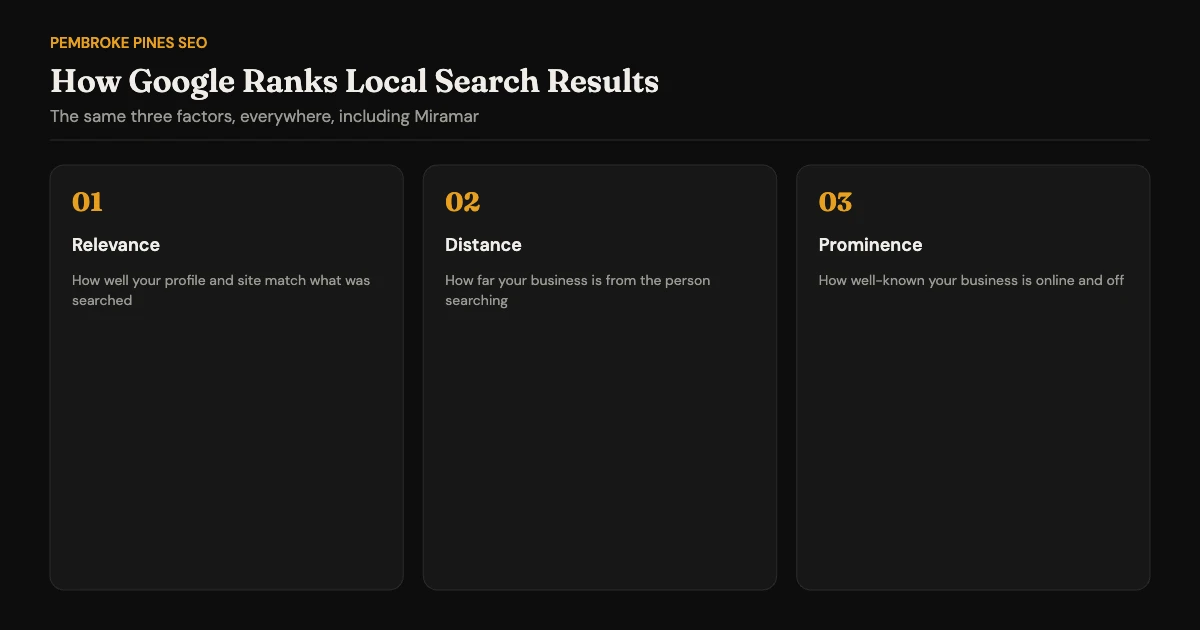
The same Google fundamentals, a different local game: what changes for a Miramar business, and what doesn’t.
Read article →