Where We Work: Local Search Across Pembroke Pines and Broward County
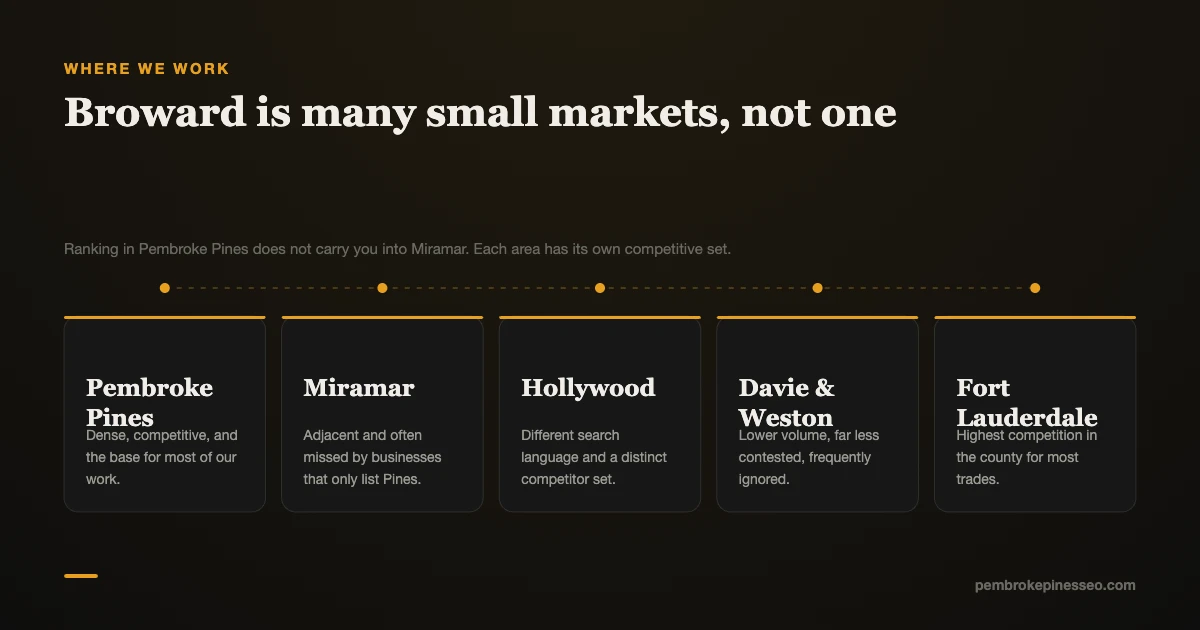
Broward County is unusual, and it changes how local search works here.
Read article →If you run a business in Miramar, Florida, you've probably wondered what "local SEO" actually involves, and whether being in Miramar changes any of it. Fair questions. Here's the honest answer: your location changes your targeting, your competitors, and which local signals matter most. It does not change how Google works. The fundamentals are the same in Miramar, Miami, or anywhere else. It's the local layer on top that makes all the difference.
This guide lays out exactly which is which, so you can spot the difference between real local SEO work and city-name window dressing, and evaluate an SEO company in Miramar, FL with confidence.
Already convinced you need help? You can request a free AI Visibility Snapshot. It scores your business across Google, Maps, and AI tools like ChatGPT, then hands you a 90-day roadmap. No contact-form maze, no pressure.
Local SEO is the work of making your business easy to find when someone nearby searches for what you offer. Picture someone in Miramar typing "plumber near me" or "best tacos Miramar FL" into their phone. Google answers with two kinds of results:
The Local Pack (map results): the three businesses with map pins, driven mostly by your Google Business Profile.
Organic results: the regular website links underneath, driven by your website's content and authority.
These are separate systems with overlapping inputs. A profile can rank without a strong website behind it, and a website can rank without a profile. But businesses that do both usually win both. That's local SEO in one sentence: your profile, your website, your reputation, and your local authority, all pulling in the same direction.
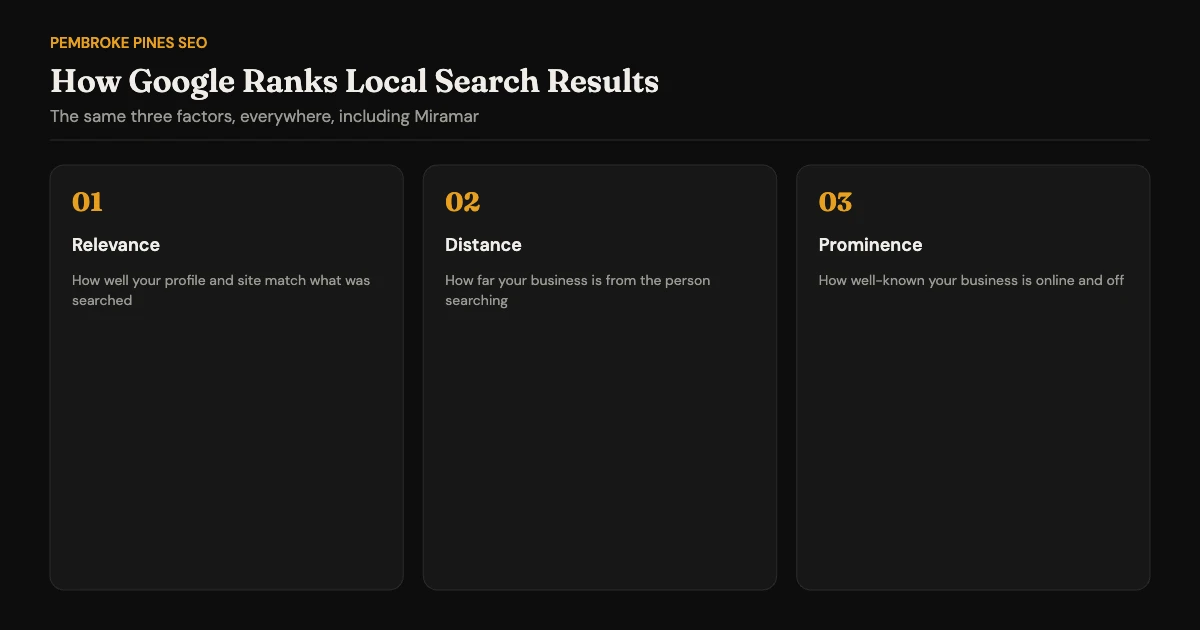
Google's own documentation says local results are mainly based on three things: relevance, distance, and popularity.
And Google says something else worth hearing: there is no way to request or pay for a better local ranking. Anyone selling you a guaranteed map position is selling something that doesn't exist.
None of this shifts because you're in Miramar. The algorithm has no Miramar mode. What changes is how these three factors play out in your particular market. That's what the rest of this guide is about.
In regular organic search, you can compete with anyone. In local search, your competition is the businesses physically around you. A plumber in Miramar isn't fighting a plumber in Tampa for the local pack. They're up against the other plumbers in Miramar, Pembroke Pines, and Hollywood whose customers search from the same streets.
That actually works in your favor. Your battlefield is small enough to study properly: who ranks for "dentist Miramar FL" right now, what their reviews look like, how complete their profiles are. You can learn more from an hour of looking at your real neighbors than from a week of reading generic SEO advice.
Here's where Miramar gets interesting. The city shares a long border with Pembroke Pines and sits minutes from Hollywood, West Park, and the Miami-Dade County line. Municipal borders run straight down the middle of neighborhoods, so people in one city see results from the next one all the time.
The practical consequence is simple: your map ranking fades with distance from your address. A customer searching two miles from your office might see you front and center while someone across town never does. That's why your map ranking can shift a few miles from your office, and it's also why a Miramar business near the Pembroke Pines border can show up in Pembroke Pines searches. Google cares where the searcher is standing, not which city name is on your lease.
Relevance works the same everywhere in principle, but its ingredients are local. Google matches businesses to searches partly through location signals: your city, your stated service areas, and the geographic terms on your profile and website. For a Miramar business, being unmistakably a Miramar business matters:
Your Google Business Profile should list Miramar as your city and your real service areas. The places you actually serve, not a wish list.
Your website should mention Miramar in natural, meaningful ways. Not by repeating "Miramar FL" in every paragraph, but by describing where you work, who you serve, and which neighborhoods you know.
If you build location pages, each one needs to earn its city name. The difference between service pages and service-area pages matters more than most agencies admit: one generic page with the city name swapped for each suburb is worse than no location pages at all.
The local touches help real people too, not just Google. Silver Lakes, Sunset Lakes, Miramar Isles. These names mean something to locals. When your content speaks their geography, it reads like it was written by someone who knows the area. Because it was.
Prominence gets built, in part, from local sources: links and mentions from organizations, publications, and directories that belong to your market. For a Miramar business, that means:
The City of Miramar's business resources page, which includes an official Local Business Directory that puts your business on a city page.
The Miramar–Pembroke Pines Regional Chamber of Commerce, a local authority link and a community signal rolled into one.
Local news, community sites, neighborhood groups, and sponsorships that generate genuine local mentions.
One backlink from a Broward County organization says more about your local prominence than ten links from unrelated national blogs. This is one of the clearest things that changes with location: your link building should start local.
Miramar isn't a generic suburb. It's a city of well over 100,000 people anchored by the Miramar Park of Commerce, one of South Florida's largest business parks, plus major employers and healthcare anchors like Memorial Hospital Miramar, all packed into a dense Broward County corridor. That shapes search behavior:
Now the other side of the ledger. Whatever an agency tells you, these fundamentals are identical in Miramar and everywhere else.
Relevance, distance, and prominence. That's the whole framework for local ranking, straight from Google's documentation. There is no separate rulebook for Florida, Broward County, or your ZIP code. Any tactic marketed as a "Miramar SEO secret" that doesn't map back to those three factors is marketing, not strategy.
Crawlability, indexing, site structure, page speed, mobile usability. None of it cares about your city. Google's SEO Starter Guide notes that some changes take effect in hours and others take months, and that timeline discipline applies universally. A site Google can't crawl properly won't rank locally no matter how many times you write "Miramar" on it.
Google's helpful-content guidance has no local exception. Content that answers real customer questions about pricing, service details, what to expect, and how you compare beats generic keyword-stuffed pages every time. And this matters doubly for local pages: a Miramar location page should tell a Miramar customer something useful, not just repeat the homepage with a different city name.
Reviews feed prominence, and Google confirms that more reviews and positive ratings can help local ranking. That mechanism is identical in every city. What differs locally is who reviews you and what they mention. Reviews that reference your Miramar location, your neighborhoods, or specific services add relevance context. Earn them honestly: ask customers directly, respond to every review, and never buy, fake, or gate them. Our breakdown of what reviews actually do, and don't do, for rankings goes deeper on this.
This is the single most common misconception we run into. Claiming and filling out your Business Profile is one essential step, not the whole job. Businesses that stop there always wonder why they don't rank. The profile is one input into relevance and prominence, while your website, reviews, citations, and local links do the rest. If an SEO company's entire "local SEO package" is a profile setup, you're buying one chapter of a book.
AI answers, from Google's AI Overviews to ChatGPT and Perplexity, are becoming part of how people discover businesses, and there's a wave of new "AEO/GEO" tactics promising shortcuts. Google's own guidance on optimizing for generative AI features cuts through most of it:
The same SEO fundamentals apply, because AI features are grounded in Google's core ranking and quality systems.
Unique, non-commodity content matters most. First-hand experience and original insight beat recycled tips.
You don't need special machine-readable files, AI-specific markup, or artificially "chunked" content. Google says so plainly.
The throughline is simple: whether the reader is a person or an AI system, being clear, specific, and genuinely useful is what gets you surfaced. A Miramar business with a well-structured profile, consistent information across the web, and content written from real local experience is already doing most of what AI visibility requires. That is exactly what the 5-signal framework for AI search visibility measures.
| What changes in Miramar | What does not change |
|---|---|
| Your local competitors (nearby businesses, not national ones) | Relevance, distance, prominence: Google's ranking framework |
| How proximity plays out across city borders | Technical SEO fundamentals: crawling, indexing, speed, mobile |
| Local relevance signals: city, neighborhoods, service areas | Helpful, people-first content as the ranking currency |
| Local prominence: local links, reviews, community mentions | How reviews influence rankings |
| Local search behavior and community-specific patterns | The fact that a Business Profile alone isn't local SEO |
| Which directories and organizations matter | What AI systems look for: clarity, accuracy, original insight |
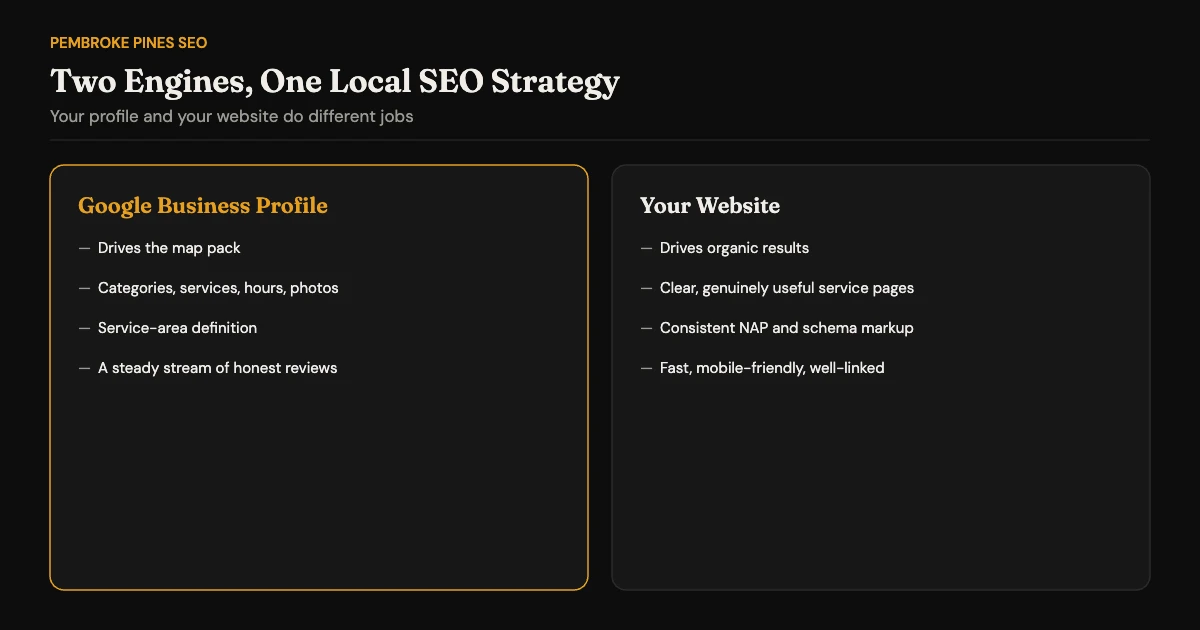
Think of local SEO as two engines.
Engine 1 is your Google Business Profile, and it drives the map pack. Feed it the right fuel: correct primary and secondary categories, complete services and products, accurate hours, a real service-area definition, photos of your actual business, and a steady stream of honest reviews that you respond to. Keep everything current. Hours, holidays, new services. Stale profiles sink.
Engine 2 is your website, and it drives organic local results while reinforcing the profile. Feed it: clear service pages, genuinely useful local content, consistent NAP (name, address, phone) information, LocalBusiness schema markup, fast mobile pages, and internal linking that makes the site easy to get around. Our guide to making your website legible to Google and AI tools covers this in detail.
The two engines reinforce each other. A strong website earns local links, which is prominence, which lifts the map pack. A strong profile sends branded searches to your site, which is relevance. Neglect either one and you cap the other.
If you're evaluating an SEO company in Miramar, FL, including us, here's what the work should concretely include. If anything is missing, ask about it.
We see these constantly, and they cost businesses real visibility:
If your business isn't showing up in Maps at all, start with our troubleshooting guide on why a business might not show up on Google Maps.
Most Broward business owners who have hired an SEO company before can't tell you exactly what it did, what it cost in total, or why they stopped. Don't be the next one. Here's how to hire better.
Red flags. Walk away if you hear any of these:
Guaranteed rankings, guaranteed number one, or guaranteed map-pack placement. Google says nobody can promise this.
"We have a special relationship with Google." Nobody does.
Secret methods they can't explain. Real SEO is explainable.
They keep ownership of your Business Profile, domain, or ad accounts, so leaving becomes painful.
Long lock-in contracts with vague deliverables and no transparent reporting.
Suspiciously cheap pricing. Two hundred a month for everything doesn't add up. Quality local SEO is skilled labor.
Questions to ask before you sign:
What exactly will you do in the first 90 days?
Who owns my Google Business Profile, my website, and my accounts?
How do you build links? Specifically, what does local link building look like for my business?
What does your monthly report include, and which metrics define success?
How do you handle reviews? Do you ever filter, gate, or incentivize them?
What happens to my rankings and assets if I cancel?
Can you show me local businesses you've helped, in their own words?
We've published a longer version as 12 questions to ask an SEO company before you sign. Take it into any sales call. Including ours.
Honest ranges, not promises.
Cost: for a small local business, legitimate local SEO programs in 2026 typically run $500 to $2,500 per month, with most serious ongoing programs landing between $1,000 and $2,500. One-off projects, like a profile overhaul or a site cleanup, get priced separately. Anything dramatically cheaper usually means dramatically less work, or work you'll regret. We've written in more depth about what local SEO typically costs in 2026.
Timelines: profile fixes and quick wins can show movement in 30 to 90 days. Map-pack movement usually takes three to six months of consistent work. Organic compounding, the kind that builds month after month, takes six to twelve months. Timelines stretch with competition. A Miramar personal injury lawyer faces a much harder climb than a Miramar dog groomer, and any honest proposal will say so.
Results vary with your market, your website's starting condition, your review base, and how consistently the work gets done. Anyone who tells you otherwise is selling, not advising.
Regular, or organic, SEO targets searches without geographic intent, like "how to fix a leaky faucet." Local SEO targets searches with local intent, like "plumber in Miramar" or "plumber near me," and optimizes for the local pack, your Business Profile, local reviews, and local signals. The technical foundations overlap heavily. The ranking surfaces and signals differ.
No. Your profile is essential for appearing in the map pack, but it's one input. Your website's content and authority, your reviews, your citations, and your local links all feed the same system. A complete profile with nothing behind it rarely wins competitive searches.
Profile-level improvements can show in 30 to 90 days. Meaningful map-pack movement typically takes three to six months. Compounding organic growth takes six to twelve. Competitive industries in Broward County take longer than low-competition ones. Treat anyone promising faster, guaranteed results with skepticism.
In 2026, legitimate local SEO programs for small businesses typically run $500 to $2,500 per month, with most substantial ongoing work in the $1,000 to $2,500 range. Cost depends on competition, the state of your website and profile, and how much content and outreach the work requires.
Not necessarily. Service-area businesses can rank in cities where they serve customers without a storefront there. Google lets you define service areas instead of showing an address. What matters is relevance and prominence for the searcher's location, not the address on your lease. That said, businesses physically closer to the searcher hold a proximity advantage.
The short version: pick the right categories, complete your profile fully, earn a steady stream of honest reviews and respond to them, keep your business information consistent across the web, build genuine local links, and make sure your website clearly describes your services and service area. There is no shortcut, and Google explicitly says local rankings can't be bought.
Yes. Google lists reviews and ratings among the signals behind prominence, one of its three local ranking factors. Reviews also influence whether searchers choose you once they see you, which is arguably more valuable than the ranking effect itself. What reviews don't do is guarantee anything on their own.
It depends on your time and your market. The profile work, review process, and basic content are very doable yourself. This guide and the checklist above cover most of it. An SEO company earns its fee on the parts that take expertise or scale: technical fixes, competitive content, local link building, and ongoing measurement in a competitive market. Be wary of any agency whose pitch boils down to "it's too complicated for you to understand."
Local SEO in Miramar isn't a different discipline. It's the same discipline pointed at a specific market. The fundamentals (relevance, distance, prominence, plus a crawlable, helpful, trustworthy web presence) don't change. What changes is everything local: your competitors, your proximity dynamics across Broward County's tight city borders, your local signals, and the community-specific ways your customers search.
Get the fundamentals right, then win the local layer. And if you'd like someone to show you exactly where your business stands today, across Google, Maps, and AI tools, request a free AI Visibility Snapshot. You'll get a scorecard and a 90-day roadmap you can act on with us or on your own.

We help established Pembroke Pines and Broward County businesses become easier to find, understand, trust and recommend across Google, Google Maps and AI tools like ChatGPT, Gemini and Perplexity.
Broward County is unusual, and it changes how local search works here.
Read article →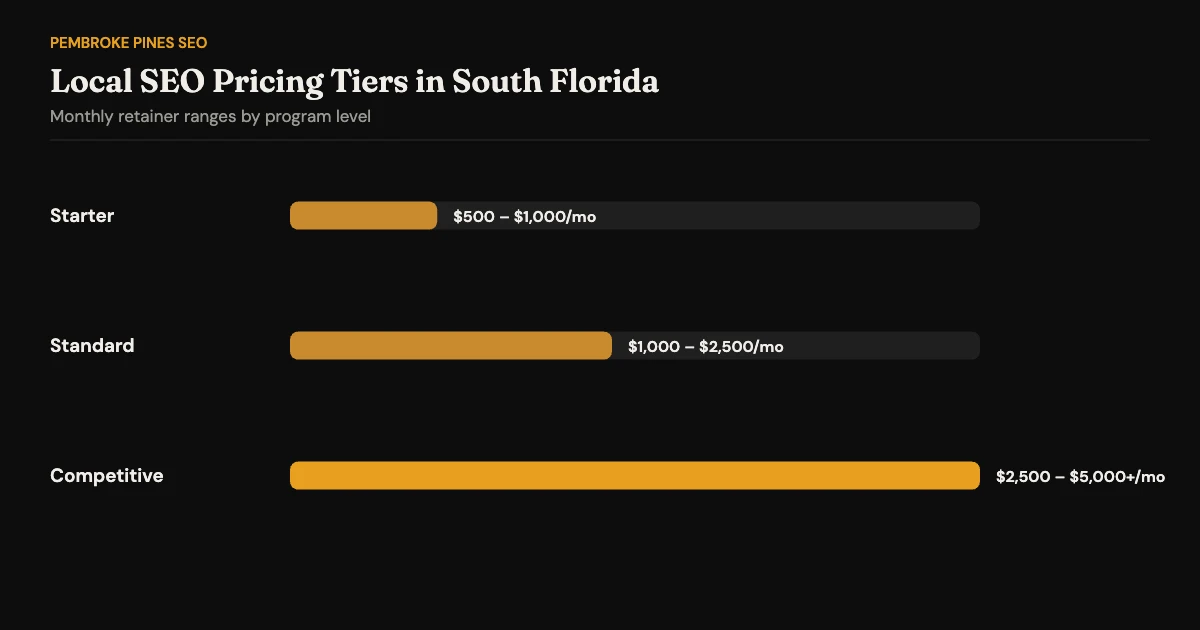
Quotes range from $400 to $4,000 a month. Here’s what that money actually buys and how to spot a fair price.
Read article →
There is a version of this problem where you are ranked low, and a version where you are not in the running at all. They feel identical from the…
Read article →