How Much Does Local SEO Cost in South Florida? An Honest Pricing Guide
Quotes range from $400 to $4,000 a month. Here’s what that money actually buys and how to spot a fair price.
Read article →If you run an HVAC company in Pembroke Pines, you already know the phone either rings or it doesn't. And when it doesn't, the question is always the same: how do the other guys show up first when someone's AC dies at 9pm?
The answer is local SEO, tuned for how HVAC customers actually search. Not generic SEO with "Pembroke Pines" pasted in. This guide breaks down what HVAC SEO really involves for a contractor in Pembroke Pines, what changes because of your trade and your city, and what stays the same no matter what an agency tells you.
Already know you need help? Request a free AI Visibility Snapshot. It scores your company across Google, Maps, and AI tools like ChatGPT, then gives you a 90-day roadmap. No pressure, no maze.
Strip away the jargon and HVAC SEO is simple: when someone nearby needs heating and cooling help, your company is the one they find, trust, and call.
Google answers those searches with two sets of results:
The Local Pack (map results): the three companies with map pins, driven mostly by your Google Business Profile.
Organic results: the regular website links underneath, driven by your website's content and authority.
For HVAC, the map pack usually matters more than it does for most trades. Emergency searches are phone-first and map-first. Someone with a dead AC at midnight isn't scrolling to page two. They're tapping the first company that looks legitimate and available.
That's the core of HVAC SEO: your profile, your website, your reviews, and your local authority, all aimed at one outcome. More of the right calls.
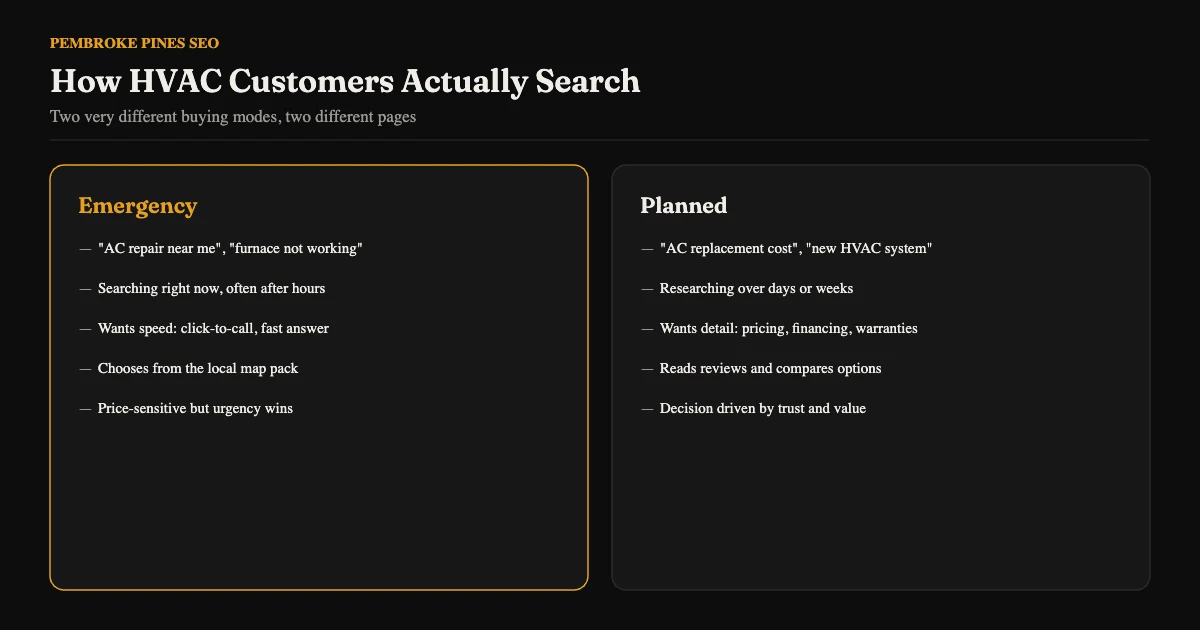
HVAC customers search in two very different modes, and your SEO has to serve both. How search behavior differs by trade is worth understanding here, because HVAC is one of the trades where the split is sharpest.
Emergency searches. High urgency, same-day intent, phone first. "AC repair near me." "AC not cooling." "Emergency AC repair Pembroke Pines." The searcher needs three answers fast: do you serve my area, can you come soon, and how do I reach you right now. Click-to-call, hours, and after-hours instructions do the heavy lifting.
Planned searches. Research mode, price-aware, longer consideration. "AC replacement cost." "HVAC maintenance plan Pembroke Pines." "New AC unit cost." These searchers want to understand the process, the pricing factors, financing and warranty, and then request an estimate.
Then there's a third group, the symptom researchers: "AC blowing warm air," "why is my AC leaking water." They aren't ready to book, but the company that answers their question honestly often gets the call when they are.
Here's what most national HVAC SEO guides get wrong about South Florida: they lead with furnaces and heating season. In Pembroke Pines, cooling dominates nearly year-round. Your money keywords are AC repair, emergency AC service, AC installation and replacement, and maintenance plans. Hurricane season, June through November, adds its own rhythm: pre-summer tune-up searches in spring, then storm-related demand. Build your keyword and content strategy around cooling first, and you'll already be ahead of every template written for Ohio.
In local search, your competition is the HVAC companies physically around you. Pembroke Pines is the second-largest city in Broward County, home to over 160,000 residents according to the city's official business page, and it has a deep bench of established HVAC contractors. You're competing with them for the same map pack, not with a national chain's blog.
That makes competitor research concrete and local. Who ranks for "AC repair Pembroke Pines" today? How many reviews do they have? How complete are their profiles? Do they run 24-hour emergency lines? Your battlefield is small enough to study in an afternoon.
Pembroke Pines shares long borders with Miramar, Hollywood, Davie, Cooper City, and Southwest Ranches. Your map ranking fades with distance from your address, which is why your map ranking can shift a few miles from your office. But it also means a shop near the Miramar border can show up for Miramar searches, and vice versa. Google cares where the searcher is standing, not which city is on your license. And how local search overlaps across Pembroke Pines, Miramar, Hollywood, Davie and Weston matters more here than in most markets, because the cities are packed so tightly together.
Florida requires HVAC contractors to hold a state license through the Department of Business and Professional Regulation. Customers in a high-scam trade notice this. Put your license number on your website, your profile, and your trucks, and link to the Florida DBPR site where anyone can verify a contractor's license. It costs you nothing, and it answers the question every homeowner is quietly asking: is this company legit?
The City of Pembroke Pines also requires every business to hold a Local Business Tax Receipt, per the city's official business page. Legitimate local credentials, displayed openly, are a quiet ranking and conversion advantage.
For an HVAC company, reviews do double duty. Google counts them toward prominence, one of its three local ranking factors. And for the homeowner with a dead AC, your star rating and recent reviews are the entire decision. Nobody calls the 3.2-star company at midnight.
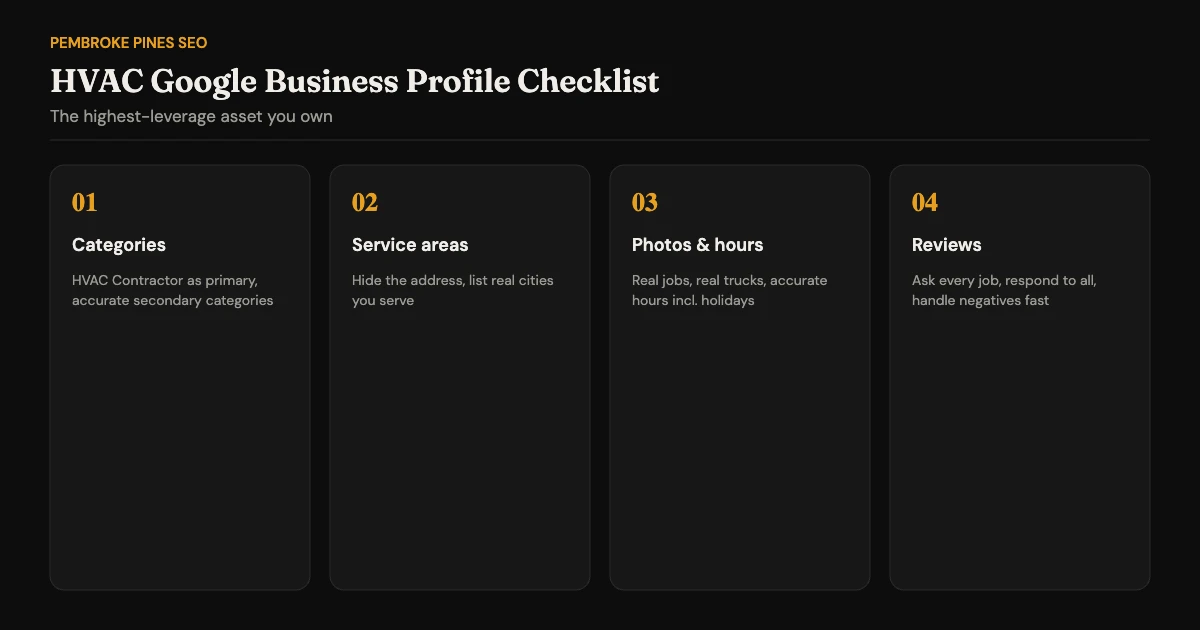
What matters most is steady velocity, not a one-time pile. A few fresh reviews every month beats fifty from three years ago. Ask after every completed job, make it easy with a direct link, and respond to every review, especially the bad ones. Our breakdown of what reviews actually do, and don't do, for rankings keeps this honest.
Most HVAC companies should use "HVAC Contractor" as the primary category, with secondaries like "Air Conditioning Contractor," "Air Conditioning Repair Service," and "Air Duct Cleaning Service" where they genuinely apply. Wrong or missing categories are one of the most common reasons HVAC companies underperform in the map pack. How Google decides who appears in the Local Pack is worth a read alongside this.
Most HVAC companies are also service-area businesses: techs in vans, not a showroom. That means hiding your street address and defining service areas by the cities and ZIP codes you actually serve. Get this wrong and Google shows your listing in the wrong places, or nowhere useful.
The trade changes the strategy. It doesn't change how Google works.
| What changes for HVAC in Pembroke Pines | What does not change |
|---|---|
| Emergency vs. planned search behavior | Relevance, distance, prominence |
| Cooling-first seasonality, hurricane-season demand | Technical SEO fundamentals |
| Local competitors (nearby HVAC companies) | Helpful, people-first content |
| Proximity across tight city borders | How reviews feed prominence |
| FL licensing as a trust signal | A GBP is one input, not the whole job |
| Review velocity expectations for emergency trades | What AI systems surface: clarity and accuracy |
| Service-area business configuration |
If you do nothing else, do this right. For HVAC, the profile is where emergency calls are won or lost.
Your website needs to meet each type of searcher where they are. That means separate, genuinely useful pages, not one "Services" page with a bullet list.
Prominence for a contractor gets built from sources that belong to your market:
Your Florida DBPR license listing, with the license number displayed openly.
The City of Pembroke Pines business resources, including the required Local Business Tax Receipt.
The Miramar-Pembroke Pines Regional Chamber of Commerce.
Equipment manufacturers and distributors you work with. Many list certified dealers.
Local sponsorships: youth sports, community events, HOA partnerships. In a city of gated communities and large 55+ developments, HOA relationships are a genuine lead channel, not just a link.
Industry-relevant directories, kept consistent. The trust signals Google and AI tools both check start with a consistent name, address, and phone everywhere.
Every HVAC owner eventually asks this. Here's the honest comparison.
| Local SEO | Google Ads | Local Services Ads | |
|---|---|---|---|
| Speed | 3 to 6 months to real momentum | Immediate | Immediate |
| Cost model | Monthly investment, compounding | Pay per click (expensive for "AC repair") | Pay per lead |
| Durability | Keeps working if you pause | Stops the day you stop paying | Stops when you pause |
| Best for | Long-term call volume and trust | Emergency demand right now | Vetted, background-checked leads |
| Catch | Takes time and consistency | HVAC click costs are brutal; needs management | Limited availability by market; Google controls the flow |
The pattern that works for most contractors: run Ads or LSAs for immediate emergency calls while SEO compounds underneath. New companies often do both for the first 90 days. Over time, organic calls cost less per lead than paid ones, and they don't vanish when the budget pauses. Anyone who tells you it's strictly one or the other is selling their one thing.
Evaluating an agency? Here's the concrete checklist. Anything missing is a gap worth asking about.
If your company isn't showing in Maps at all, our troubleshooting guide on why a business might not show up on Google Maps is the place to start.
Red flags:
Guaranteed rankings or guaranteed call volume. Nobody can promise this.
They won't explain what they'll actually do each month.
They own your profile, website, or ad accounts, so you can't leave.
They resell shared leads while calling it "SEO."
Suspiciously cheap, or suspiciously vague about pricing.
No reporting you can understand, or reporting that only shows vanity rankings.
Questions to ask:
What will you do in the first 90 days, specifically for an HVAC company?
How do you handle emergency-keyword strategy vs. install-keyword strategy?
Who owns my Business Profile, website, and tracking accounts?
How do you build local links for a contractor?
What's your review strategy, and do you ever filter or incentivize reviews?
What does the monthly report include, and how do we tie it to actual calls?
What happens to everything if I cancel?
Take our longer list of questions to ask an SEO company before you sign into every sales call, including ours.
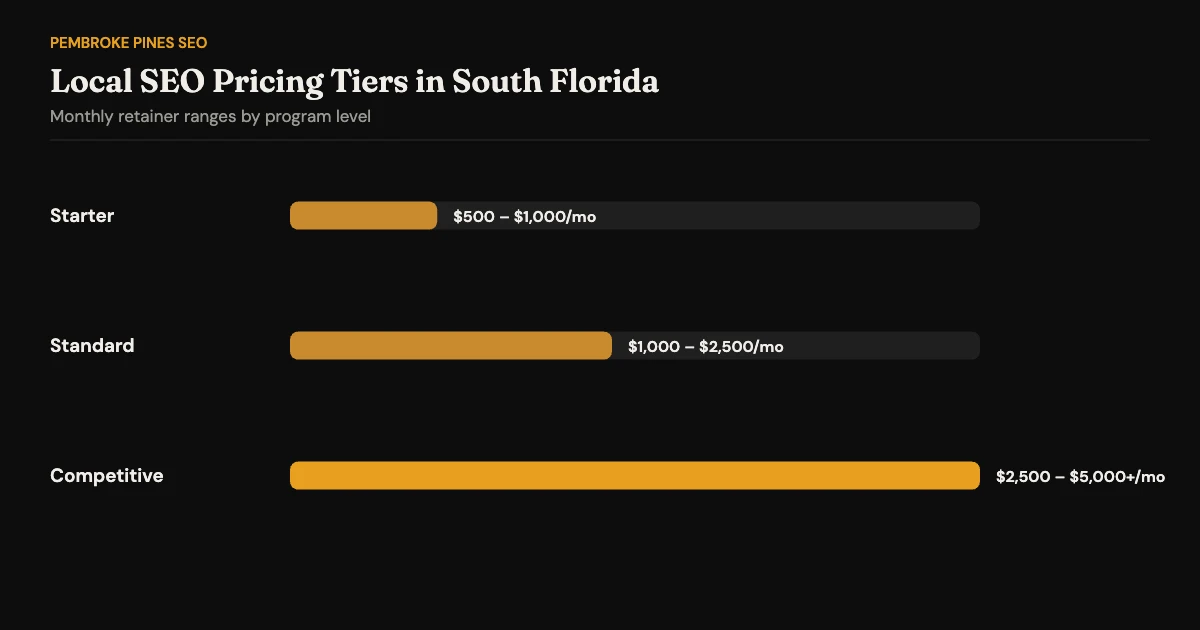
Honest ranges, not promises. For a single-location HVAC contractor, legitimate local SEO programs typically run $1,000 to $3,000 per month, with most serious ongoing work in that band. Lighter programs can sit lower; multi-city or aggressive campaigns go higher. We've written more about what local SEO typically costs.
Timelines: profile and quick-win improvements can show movement in one to three months. Map-pack movement usually takes three to six months. Compounding organic growth takes six to twelve months. HVAC in Broward County is a competitive trade, so expect the longer end until your prominence catches up. Results vary with competition, your starting point, and how consistently the work gets done.
For a single-location HVAC contractor, legitimate local SEO programs typically run $1,000 to $3,000 per month. Lighter programs can cost less; multi-city or aggressive campaigns cost more. Cost depends on your market's competitiveness, the state of your website and profile, and how much content and outreach the work requires.
Profile improvements can show movement in one to three months. Map-pack movement usually takes three to six months of consistent work. Compounding organic growth takes six to twelve months. HVAC in Broward County is competitive, so plan for the longer end of those ranges.
The short version: choose the right categories, set up your service areas honestly, complete your profile fully, earn a steady stream of reviews and respond to them, keep your business information consistent across the web, and build genuine local links. There is no shortcut, and Google says local rankings can't be bought.
Prioritize by intent. Emergency keywords first ("AC repair near me," "emergency AC repair Pembroke Pines"), then installation and replacement ("AC installation," "AC replacement cost"), then symptom and research queries ("AC blowing warm air"). In South Florida, weight cooling terms far above heating terms.
They do different jobs. Ads and Local Services Ads deliver calls immediately but stop when you stop paying, and HVAC click costs are high. SEO takes months but compounds, and organic calls cost less over time. Most contractors do best running paid ads for immediate emergency demand while SEO builds underneath.
Only if each page is genuinely useful and different. One strong page per city you truly serve, with real local detail, can work. Five near-identical pages with the city name swapped will underperform and can trigger thin-content issues. Quality over quantity, always.
Yes. Residential is emergency-driven and review-driven; commercial is relationship-driven and contract-driven. They deserve separate messaging and often separate pages. The keywords, the proof points, and the calls to action are different for a homeowner with a dead AC versus a property manager vetting a maintenance contract.
The buying modes. Emergency searches are phone-first, map-first, and won in seconds on trust signals. Planned searches need education and estimate funnels. Seasonality is cooling-first in Florida, not heating-first. And review velocity matters more than in most trades because the customer is often stressed and deciding fast.
HVAC SEO in Pembroke Pines isn't a different discipline. It's the same discipline aimed at a specific trade in a specific market: emergency intent, cooling-first demand, tight city borders, and customers who decide in seconds based on trust. Get the fundamentals right, then win the local layer: exact categories, honest service areas, real reviews, useful pages for each buying mode, and measurement tied to actual calls.
And if you'd like to see exactly where your company stands today, across Google, Maps, and AI tools, request a free AI Visibility Snapshot. You'll get a scorecard and a 90-day roadmap you can act on with us or on your own.

We help established Pembroke Pines and Broward County businesses become easier to find, understand, trust and recommend across Google, Google Maps and AI tools like ChatGPT, Gemini and Perplexity.
Quotes range from $400 to $4,000 a month. Here’s what that money actually buys and how to spot a fair price.
Read article →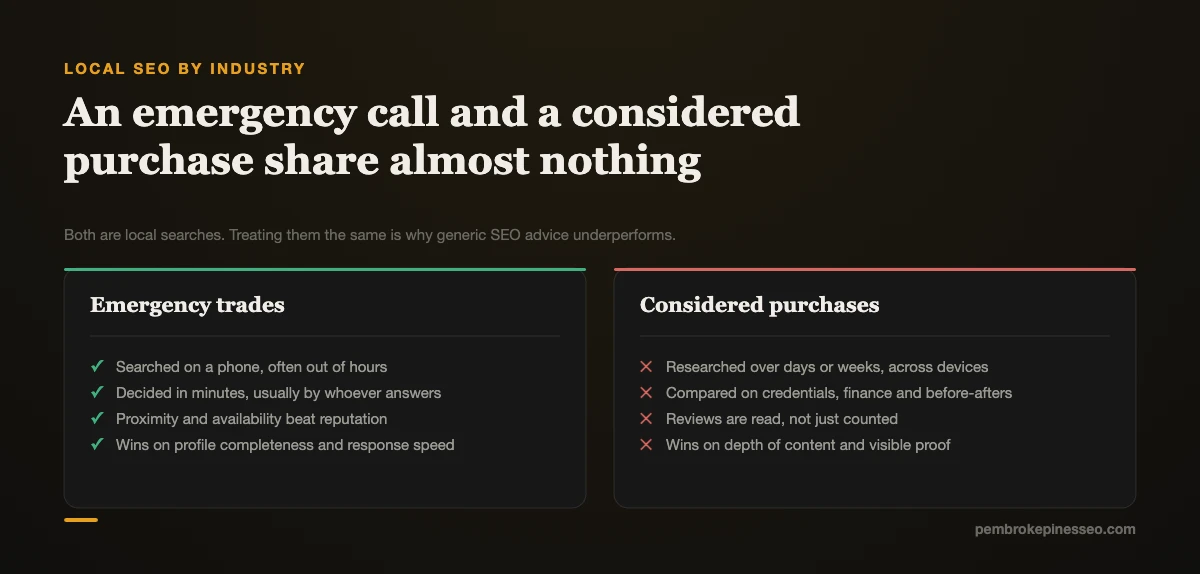
A homeowner whose air conditioning died at 2pm in August and a homeowner considering Invisalign are both "local searches." They have almost nothing…
Read article →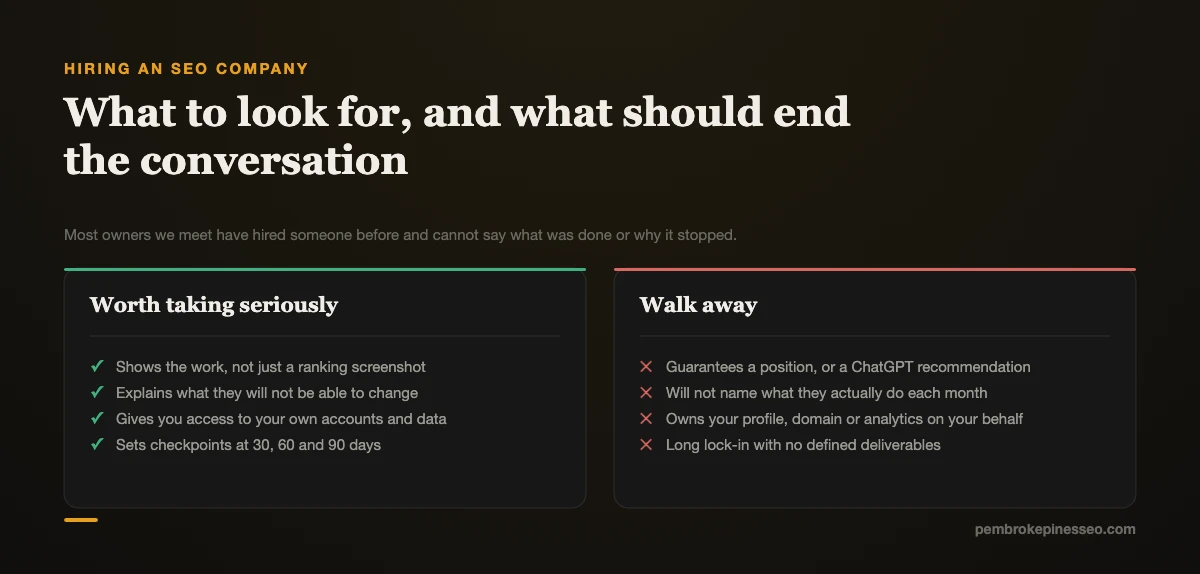
Most Broward business owners we talk to have hired an SEO company before. A meaningful number of them cannot say what that company did, what it cost…
Read article →